

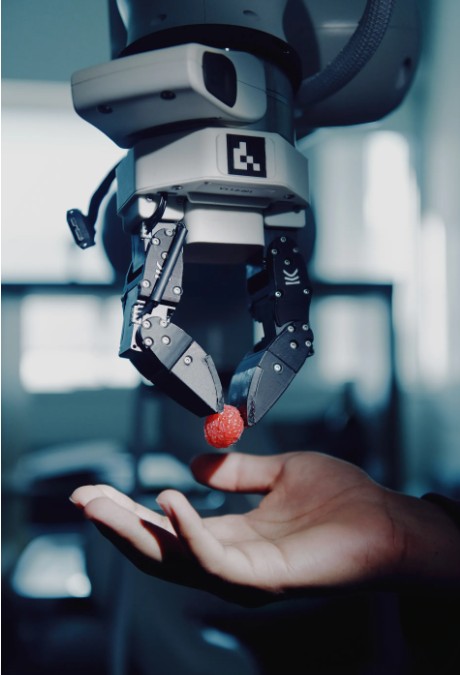
A new generation of robots is beginning to show signs of what could become a “ChatGPT moment” for physical intelligence. In the Wired.com article (full article available to subscribers), a visit to robotics startup Eka reveals machines that move with a level of fluidity and adaptability rarely seen before, suggesting that dexterity, not just computation, may define the next leap in artificial intelligence.
Unlike traditional industrial robots, which operate with rigid, preprogrammed motions, Eka’s machines display a more natural style of interaction. Their pincers can gently probe objects, adjust grip strength, and recover from mistakes in real time. In one demonstration, a robot successfully picks up a light bulb, repositions it after fumbling, and screws it into a socket, a task that requires fine motor control and feedback awareness.
The breakthrough lies in how these robots are trained. Rather than relying heavily on human demonstrations, Eka uses reinforcement learning in detailed simulations. The robots practice thousands of variations of tasks, learning through trial and error. This approach allows them to develop what researchers describe as “physical intelligence,” combining vision, force sensing, and motion into a unified system.
This marks a shift from earlier efforts such as OpenAI’s Dactyl, which demonstrated limited dexterity under tightly controlled conditions. Eka’s robots, by contrast, can adapt to varied objects and unpredictable situations, from handling keys to sorting irregular items such as food. These capabilities hint at broader applications in logistics, food processing, retail, and even household environments.
The article frames this progress as analogous to early large language models. Just as early systems such as GPT-1 showed glimpses of linguistic reasoning before scaling transformed them, today’s robots exhibit early signs of general physical competence.
Skepticism remains, particularly around whether simulation-based learning alone can scale to real-world complexity. Still, the progress suggests that solving dexterity may unlock enormous economic value, given how much human labor depends on skilled hand movements.
The emerging insight is clear: achieving humanlike manipulation is one of the hardest problems in robotics. If these early advances continue to scale, robots may soon transition from specialized tools to versatile agents capable of operating in the messy, unpredictable physical world.
