

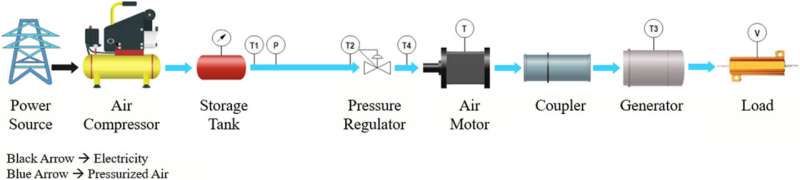
Researchers at the University of Sharjah present a digital twin architecture tailored for compressed air energy storage (CAES) systems, described in a paper published in Energy, tells Tech Xplore. The system uses a set of sensors to capture real-time data (temperature, pressure, voltage, etc.), and applies unsupervised machine learning (specifically relational concept analysis) to detect early warning signs of three key fault types: leaks (F1), coupling faults (F2), and load faults (F3).
Rather than relying on large volumes of labeled data or heavy supercomputing, the approach emphasizes pattern-recognition via a “pattern library” of invariant operating behavior under varied conditions. Once these patterns are catalogued, they help the twin monitor system health (HS) continuously. The architecture is modular and designed for reuse: once a “pattern” is formulated, it can be applied to other similar systems (e.g., batteries, turbines, hydrogen storage) without full redesign.
In experimental validation, the twin was implemented on a CAES testbed with Arduino-based sensors, tracking real-time changes and identifying faults before they escalated. The authors claim it helps reduce downtime, cut maintenance costs, and boost reliability for renewable-energy-storage infrastructure.
For engineers and practitioners in the energy-storage sector, this means a move from reactive maintenance to predictive control, with a lightweight, scalable digital-twin model that balances practicality with insight. Also, by the emphasis on modular design patterns, it opens the door to libraries of twin modules that accelerate deployment across systems.
This research shows a solid step toward making digital twins not just high-fidelity simulations, but actionable tools for sustainability-oriented infrastructure.
