

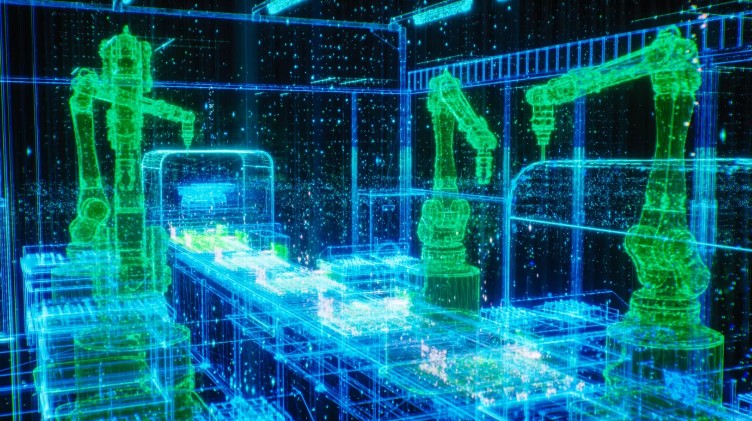
Manufacturing is moving past traditional automation toward systems that can run with minimal human intervention. At the center of that shift are digital twins and intelligent automation, technologies that together promise autonomous, self-optimizing production lines. In this Design News article, digital twins are described as more than static digital replicas. They now act as operational process models that mirror and interact with live factory data to guide decisions and actions across workflows. That real-time connection lets manufacturers track performance, test scenarios, and predict outcomes before making changes on the physical floor.
Intelligent automation combines robotic process automation with artificial intelligence. This mix lets systems interpret data, adjust processes, and even make decisions based on evolving conditions. Rather than executing fixed scripts, AI-enabled controllers can respond to fluctuations in demand, material supply, and equipment performance. When paired with digital twins that reflect current states of machines and products, these systems can adjust production schedules, routing, and maintenance without direct human input.
The article positions this convergence as the next stage of smart manufacturing. “Lights-out” factories, in which machines coordinate tasks, identify issues, and execute fixes, are no longer theoretical. Instead, vendors and adopters are building ecosystems where predictive models and automated decision engines interact continuously. This promises gains in efficiency, agility, and cost control by reducing manual oversight and eliminating delays between sensing a problem and correcting it.
Broader industry forecasts underpin these ideas. Reports project nearly trillion-dollar growth in smart manufacturing over the next decade, driven by demand for agility and the need to balance quality and speed. A well-designed digital twin infrastructure becomes the heart of these autonomous systems, linking sensor data with AI reasoning engines that anticipate issues before they occur.
Realizing autonomous manufacturing at scale will still require integration work, standards for data exchange, and skilled teams to manage transition. But the blend of digital twins and intelligent automation points to factories that think and act on their own, reshaping production for a more dynamic market.
