

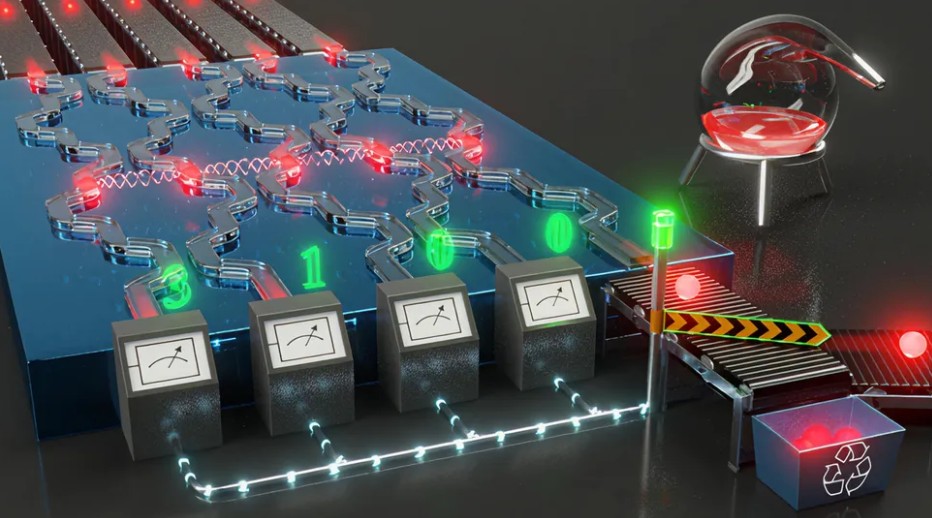
A new experimental breakthrough in photonic quantum computing focuses on a problem that has long limited the field: error-prone light. The Live Science article reports that researchers have developed a method called photon distillation, designed to remove faulty light signals before they interfere with computation.
Photonic quantum computers use beams of photons manipulated through mirrors and beam splitters to perform calculations. Unlike superconducting systems, which rely on electrical circuits and require extreme cooling, these light-based systems can operate at room temperature. This makes them attractive for scaling, but their main weakness lies in the quality of photons themselves. Because photons are inherently imperfect, many are “bad” or noisy, and even a small number of such errors can derail a quantum computation.
The photon distillation technique addresses this issue directly. Instead of trying to correct errors after they occur, the method filters out unreliable photons in advance, ensuring that only high-quality quantum states are used. Researchers describe this as a “net-positive” approach to error mitigation, meaning the process improves overall system reliability without introducing additional complexity that cancels out its benefits.
Error control is widely seen as the central barrier to building large-scale, fault-tolerant quantum computers. In photonic systems, where photons are constantly in motion and interacting, error rates tend to be higher than in other architectures. By reducing noise at the input stage, the new method could significantly lower the burden on downstream error-correction systems.
The advance moves photonic quantum computing closer to achieving quantum advantage, where quantum machines outperform classical supercomputers on meaningful tasks. While still experimental, the findings suggest that scaling light-based systems may be more feasible than previously thought. If integrated into practical devices, photon distillation could become a foundational step toward building reliable, large-scale quantum processors powered entirely by light.
