

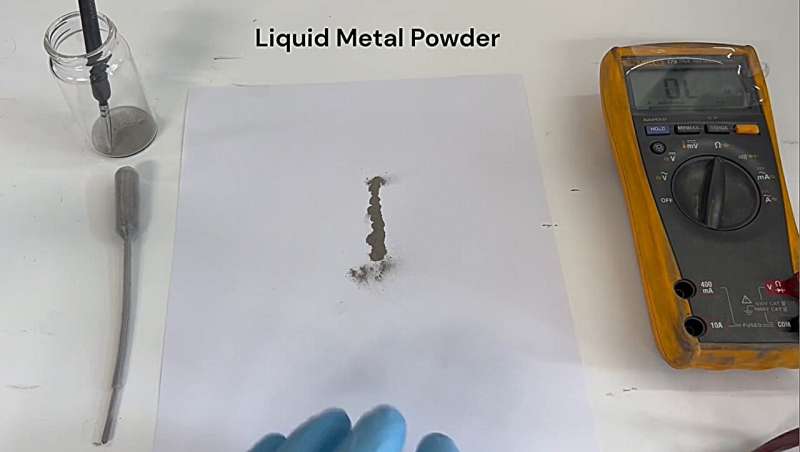
Researchers have developed a novel electronic material that allows conductive circuits to be created simply by drawing them on surfaces such as paper, leaves, or flexible substrates. The technology relies on a mechanochemically activated liquid metal powder, which forms electrically conductive pathways when pressure is applied. The work was led by Professor Inkyu Park’s team at the Korea Advanced Institute of Science and Technology (KAIST) in collaboration with the Electronics and Telecommunications Research Institute, tells Tech Xplore.
Traditional flexible electronics often require specialized manufacturing processes, such as printing conductive inks or depositing thin metallic films. These techniques typically involve complex equipment and fabrication steps. The newly developed powder simplifies the process by enabling circuits to be created directly through mechanical activation. When pressure is applied by drawing or pressing the powder onto a surface, the material transitions into a conductive state, forming electrical pathways that can function as working electronic circuits.
The powder is made from liquid metal particles that are engineered to remain stable until they are mechanically triggered. During activation, the particles rupture or rearrange under pressure, creating continuous conductive connections. This approach allows users to define electronic patterns manually while maintaining reliable electrical performance.
One of the most significant advantages of the material is its versatility. Circuits can be drawn on a wide range of surfaces, including flexible materials used in soft robotics, wearable health monitors, and other emerging electronic systems. Because the technology supports reconfigurable electronics, circuits can potentially be modified or replaced without complex fabrication steps.
The researchers believe this approach could contribute to more sustainable and adaptable electronic devices. By reducing the need for complex manufacturing infrastructure and enabling direct user interaction with circuit creation, the liquid metal powder offers a simpler pathway to building flexible electronic systems. The technology could ultimately support applications in wearable sensors, educational electronics kits, and rapid prototyping of electronic devices.
