

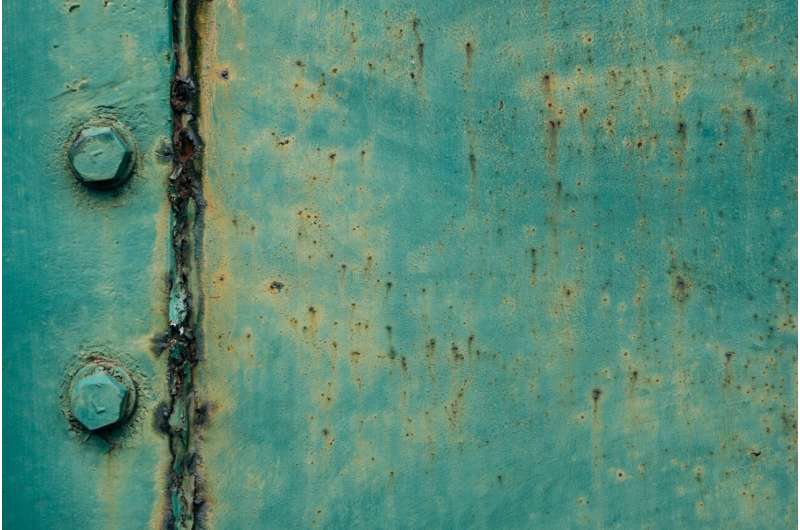
Researchers have developed a simpler method for detecting corrosion in iron and steel structures, including damage hidden beneath protective coatings. The approach combines a small number of spectral measurements with image texture analysis, making it suitable for commercial multispectral cameras mounted on drones, tells Tech Xplore.
Corrosion is a persistent problem for merchant ships, coastal infrastructure, and maritime facilities built from iron and steel. Although these materials provide substantial strength, exposure to harsh environments can gradually weaken them and potentially lead to structural failure. Regular inspection is therefore essential, but conventional visual assessments can require significant time and may miss damage developing beneath painted surfaces.
Drone-based optical inspection offers a way to examine large or difficult-to-access structures more efficiently. However, existing multispectral cameras have generally been limited to detecting visible surface corrosion. Thermal imaging can reveal corrosion beneath paint, but it requires a heating source, adding complexity to inspection systems.
Emma Hernández-Suárez and her colleagues developed an alternative that requires no heating. Their method uses information from only three spectral bands, at wavelengths of 518, 655, and 838 nanometers, together with a texture feature to distinguish corroded areas.
The researchers developed their corrosion-detection algorithm using samples produced in a salt spray chamber. They then evaluated it on a separate collection of samples obtained from an industrial environment. These samples had unknown coatings, providing a more realistic test of the method’s ability to work under varying conditions.
The algorithm achieved accuracy exceeding 90% when identifying both surface and subsurface corrosion across coatings with different colors and characteristics.
Because the algorithm is freely available and compatible with commercial drone-mounted multispectral imaging systems, it could make corrosion monitoring more practical. The approach may reduce inspection costs while allowing operators to evaluate large structures from safer locations, improving maintenance of ships, coastal facilities, and other steel infrastructure.
