

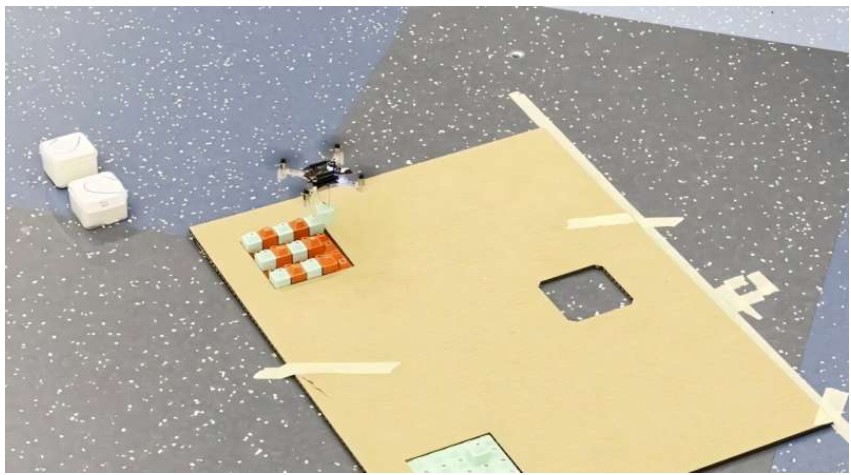
Researchers at Carnegie Mellon have developed a system of AI-guided drones capable of building physical structures via additive manufacturing in locations that are difficult or dangerous for heavy equipment, tells Tech Xplore. The drones carry materials—magnetic blocks in the proof-of-concept—and a large language model (LLM) translates high-level goals (i.e., “build a bridge”) into actionable commands.
In experiments, the team set up a 5 × 5 grid and challenged the drones to assemble specified shapes. With an overhead camera monitoring the process, the system detected misplacements, gaps, or inefficiencies in real time. Through a closed feedback loop, when errors occurred, the LLM prompted drones to adapt the plan instead of aborting and starting over. The result: successful builds in about 90% of trials.
The significance lies in extending additive manufacturing beyond the shop floor or terrestrial 3D printer to aerial construction. The potential use cases include disaster relief (building shelters when roads are blocked), remote terrain (such as mountainous or arctic zones), and even space habitats (where heavy cranes may not be feasible). The paper emphasizes that heavier or remote machinery may be impractical in many settings.
The next steps for the team include transitioning from magnetic blocks to more realistic or dynamic building materials, conducting field tests outside the lab, and refining the LLM’s translation of design intent into drone instructions. They also plan to scale to more complex geometries and multi-drone coordination for real-world infrastructure.
For engineering professionals, this work highlights a convergence of robotics, materials science, AI (especially LLMs), and construction engineering. Instead of heavy ground machinery, a fleet of smart drones may access inaccessible sites, adapt on the fly, and build structures autonomously. The challenge shifts from logistics and manpower to system integration, drone autonomy, materials innovations, and control-loop reliability.
The research opens a new frontier where aerial robots don’t just inspect or deliver, they construct.
