

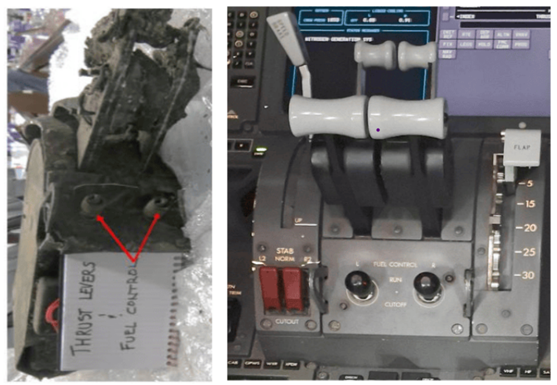
The Air Accident Investigation Bureau (AAIB) of India has released its preliminary findings on the crash of Air India Flight AI171, a Boeing 787-8 (VT-ANB), which occurred shortly after takeoff from Ahmedabad on June 12, 2025. The report reveals that both GEnx-1B engines experienced an “uncommanded” shutdown within seconds of rotation due to the fuel control switches being moved from RUN to CUTOFF during takeoff.
The report provides a clear technical sequence—fuel cutoffs, confusion in the cockpit, no system faults—but does not assign a cause. The central mystery remains: why were both engine fuel switches moved?
Flight data and cockpit voice recordings confirm that the switches were manually moved to CUTOFF 3–4 seconds after takeoff, leading to total loss of thrust. The aircraft started to lose altitude before crossing the airport perimeter wall. One pilot is heard questioning the fuel cutoff, while the other denies action, indicating possible inadvertent input or confusion. No mechanical, electrical, or maintenance anomalies were found in the engines, full authority dual engine control (FADEC) systems, or aircraft fuel systems. Although engines were put back to RUN 10 seconds after CUTOFF, the aircraft had lost so much altitude that FADEC, which is called the “brain” of an aircraft engine, had no time to achieve full control. The Ram Air Turbine (RAT) was deployed as designed, providing limited power and hydraulic pressure, but the aircraft stalled and crashed shortly after.
The report highlights a prior FAA Service Bulletin (2018) cautioning about the potential misalignment of the locking mechanism in the 787’s fuel control switches. However, this was not an Airworthiness Directive, and Air India had not retrofitted its fleet accordingly. The investigation remains open, with further analysis pending on human factors, switch design tolerances, and procedural safeguards.
No conclusive cause has been attributed, but the sequence indicates a critical interface vulnerability between human input and engine control during high-workload phases of flight.
