

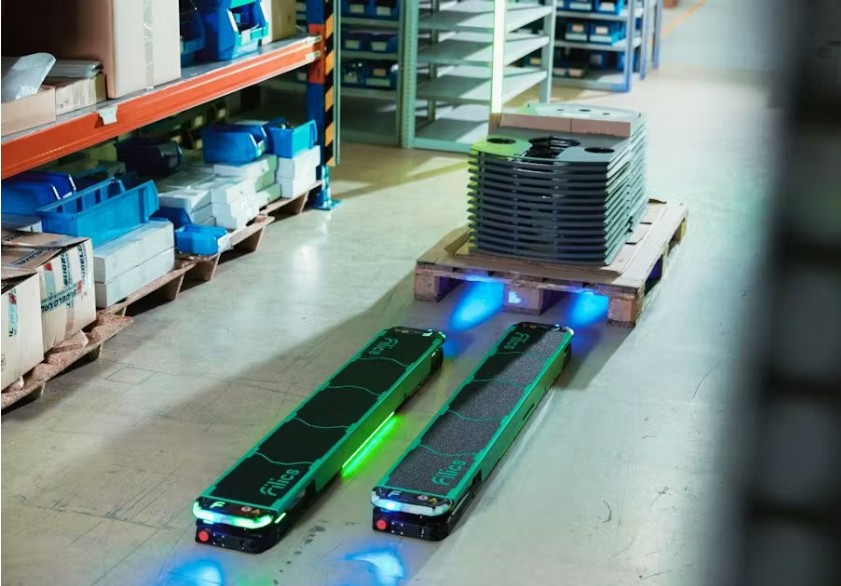
A new class of autonomous mobile robots is moving away from traditional hydraulic systems, adopting electric lift mechanisms and quasi-direct drive (QDD) motors to achieve higher precision, efficiency, and controllability. This shift reflects broader changes in industrial automation, where flexibility, safety, and energy efficiency are becoming central design priorities, tells Machine Design.
Hydraulic systems have long powered heavy lifting and motion in industrial robots, but they introduce complexity, maintenance demands, and limited control fidelity. In contrast, electric lift systems offer cleaner operation, reduced maintenance, and more precise positioning, making them better suited for dynamic environments such as warehouses and collaborative workspaces.
At the core of this transition are QDD motors, which combine high torque with low gear reduction. Unlike conventional geared systems, QDD actuators enable smoother motion, faster response, and greater backdrivability. This allows robots to interact more safely with humans and adapt quickly to changing loads or terrain.
These advances are particularly important for applications involving pallet handling, mobile platforms, and even human transport systems. Electric actuation enables finer control over lifting and movement, supporting tasks that require both strength and precision. The result is a new generation of robots capable of operating in mixed environments, where humans and machines share space.
The transition also aligns with sustainability goals. Electric systems reduce energy consumption and eliminate hydraulic fluids, lowering environmental impact while simplifying system design. At the same time, improved control algorithms and integrated sensors enhance navigation, stability, and task execution in real time.
As autonomous mobile robots continue to evolve, the move toward electric lift systems and QDD motors marks a fundamental redesign of their mechanical architecture. By replacing hydraulics with intelligent, responsive actuation, these systems are enabling safer, more adaptable, and more efficient automation across industrial and commercial settings.
