

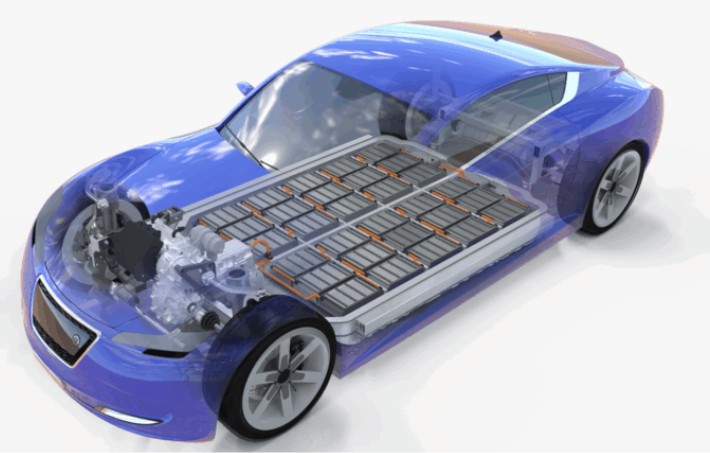
The shift from combustion engines to electric powertrains brings fresh design challenges, especially around batteries. The 3DS Blog from Dassault Systèmes’ SIMULIA team argues that to meet performance, safety, and integration goals, automakers must adopt a holistic, multiscale simulation workflow that spans from molecular chemistry to full-vehicle behavior.
In this workflow, battery cell engineering acts as the linchpin. The process begins with molecular or material-level modeling (e.g., using BIOVIA) to explore new anode, cathode, or electrolyte formulations. Next, those material properties feed continuum-scale simulations of cell-level electrochemical performance, capturing ion diffusion, thermal losses, voltage behavior under charge/discharge cycles, and how degradation evolves over time.
These cell models don’t operate in isolation; they must also address mechanical stresses, swelling, and structural loads. As a battery charges or discharges, it expands, contracts, or faces bending loads. Integrating structural simulation reveals whether the cell can maintain mechanical integrity over many cycles.
Because full high-fidelity models tend to be computationally heavy, the blog highlights model order reduction techniques. These methods compress complex models into simplified surrogates that retain critical physics yet run much faster. That lets engineers iterate more quickly or run system-level studies.
Thermal management is another key piece. The blog emphasizes coupling electrochemical and thermal models (often via CFD and tools such as PowerFLOW) so designers can anticipate hot spots, optimize cooling channels, and avoid temperature-driven degradation.
Finally, the optimized cell model is integrated into module and pack simulations, then into the vehicle model itself. That allows evaluation of tradeoffs such as weight distribution, structural stiffness, crash behavior, and how battery HVAC loads affect range.
The future of EV battery design lies not in trial and error but in tightly integrated simulation across scales. When done right, engineers can catch problems early, explore more design space, and deliver safer, more capable batteries from cell to car.
