

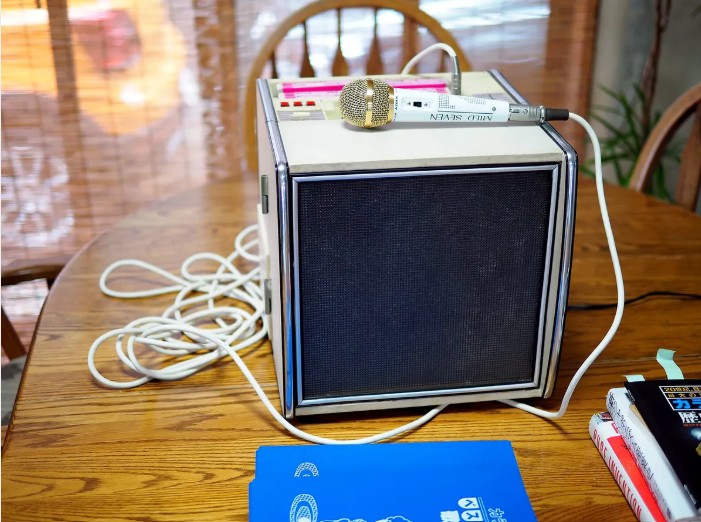
In 1967, Shigeichi Negishi of Tokyo’s Nichiden Kogyo invented what would become the first karaoke machine, now honored by IEEE as a Milestone for its cultural and technological significance. What began as a way for Negishi to practice pitch during work evolved into a compact 30-cm cube known as the “Music Box.” It housed a four-tape 8-track player, a mixer, and a microphone, all engineered into a single device, tells IEEE Spectrum.
The engineering here is simple but clever. The 8-track system uses magnetic tape cartridges with loops of tape, each holding about eight songs. A motor pulls the tape across a playback head, and a sensing strip signals the system to switch tracks via a solenoid coil triggering movement. Negishi added a microphone input with an amplifier and a mixing circuit, enabling singers to overlay their voice onto the instrumentals and adjust levels in real time.
Later enhancements included a coin-acceptor in 1969, transforming it into the “Sparko Box,” and turning karaoke from a novelty into a pay-per-use entertainment device found in bars and banquet halls. Its engineering opened the door to modern karaoke’s global boom.
By integrating audio playback, live vocal mixing, and user-friendly interfaces into a self-contained device, Negishi delivered a technical innovation with wide appeal. The machine’s components, such as the microphone amplifier, analog mixing circuit, tape deck mechanics, and user control buttons, show how relatively simple analog electronics and mechanics solved a creative problem and spawned an entertainment revolution.
IEEE dedicated this invention as a Milestone in Tokyo in June 2025, recognizing how this straightforward engineering achievement created a beloved pastime worldwide.
