

Sending humans beyond low Earth orbit again demands more than powerful rockets. It requires a tightly integrated system of materials, life-support strategies, and human-centered engineering that can sustain astronauts in one of the harshest environments ever encountered, tells Standford Report.
At the core of the Artemis II mission is a conservative yet evolving approach to materials. Aerospace engineering relies heavily on “flight heritage,” meaning proven materials are favored because of the extreme risks involved. Every component must pass rigorous testing for structural integrity, radiation resistance, and safety in closed environments.
Still, innovation is advancing. Carbon-fiber composites now offer strength comparable to steel at a fraction of the weight, allowing engineers to optimize structures by aligning fibers along stress paths. Additive manufacturing is also reshaping spacecraft production, enabling complex geometries to be built directly with minimal waste, improving both efficiency and performance.
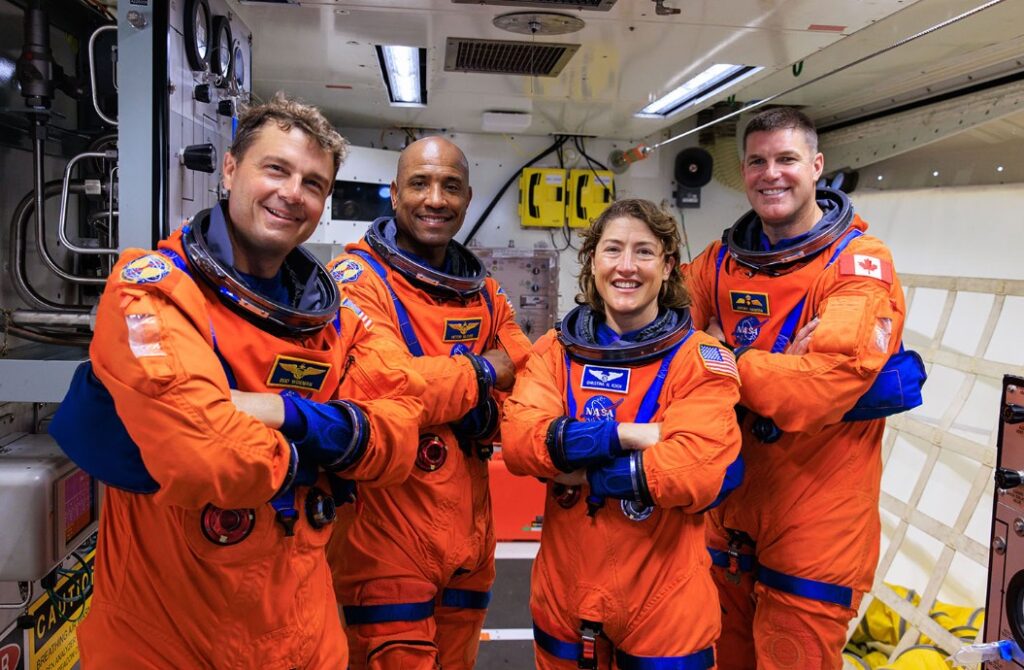
Spacesuits represent another layer of complexity. They must function as personal spacecraft, balancing flexibility, durability, and life support. Materials must withstand pressure differences, temperature extremes, and abrasion while remaining safe for long-duration wear. These requirements push textile and composite technologies to their limits.
Food, often overlooked, is equally engineered. Every gram launched into space carries a cost, so meals are designed to be compact, shelf-stable, and nutrient-dense. Freeze-drying and rehydration techniques allow astronauts to consume balanced diets without refrigeration, while flavors are enhanced to counter reduced taste sensitivity in microgravity.
The broader challenge lies in integration. Materials, manufacturing methods, wearable systems, and nutrition must work together within strict constraints of mass, volume, and reliability. Artemis II highlights a shift toward optimizing entire systems rather than individual components.
This mission serves as a proving ground for future lunar and deep-space exploration, where success depends not just on reaching space, but on sustaining human life within it.
