

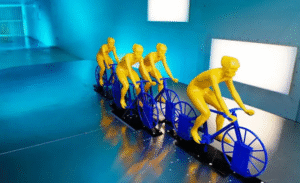
Engineers at Heriot-Watt University, partnering with Ansys, used high-fidelity CFD simulations and wind-tunnel validation to analyze how different team formations in cycling—including those used in the Tour de France—affect aerodynamic drag on a protected rider. An article by The Engineer says that they tested 27 configurations with three-, four-, and five-rider formations using Ansys’ simulation tools to quantify drag reduction.
Results showed dramatic performance gains:
- A three-rider inverted triangle cuts drag on the protected rider to ~39% of solo effort.
- A four-rider diamond formation lowers drag further, to ~38%.
- The most effective is a five-rider “train,” with two pairs abreast ahead of the leader—reducing drag to just ~24%, a 76% saving compared to solo riding.
From a CAE perspective, the project demonstrates:
- Use of CFD simulation to model complex airflow and wake interactions between dynamically positioned cyclists.
- Integration of cloud-based solvers for rapid iteration.
- Validation via wind-tunnel data to correlate numerical models with physical performance.
This study shows how CAE tools, long used in automotive and aerospace, can be repurposed for sports strategy—bridging CAD, simulation, and biomechanics. For CAD professionals, it underscores the value of mesh design, turbulence modeling, and geometry optimization—even in non-traditional domains such as race tactics.
And yes, these findings are applicable to real-world Tour de France strategy: formations traditionally used by teams during leader recovery or protective drafting now get scientific backing—with measurable energy savings grounded in CAE analysis.
