

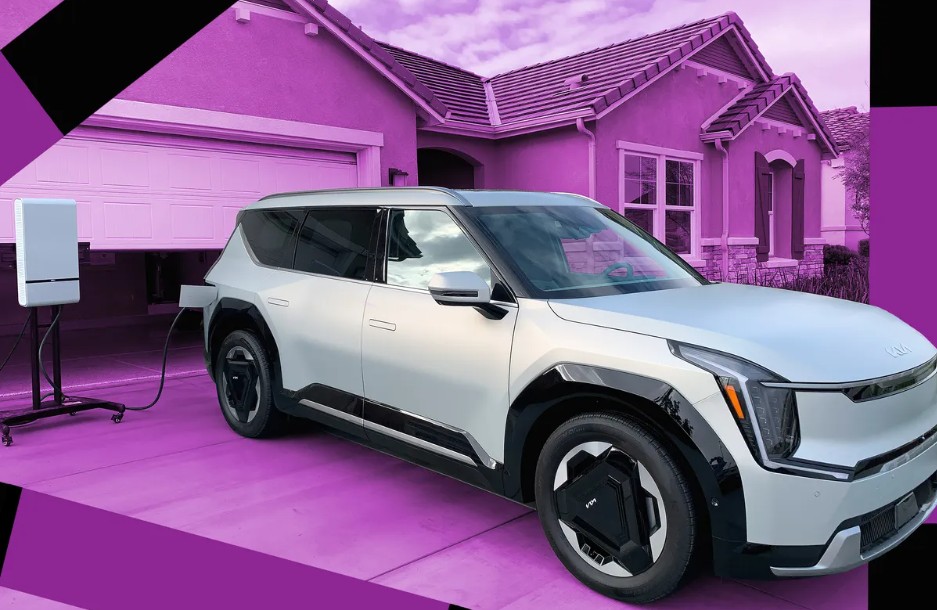
This article from IEEE Spectrum covers a residential pilot in Menifee, California, where six newly built homes are equipped with electric vehicles and bidirectional charging systems to supply household power.
Each of these homes uses a host vehicle, a Kia EV9, connected to a bidirectional charger from Wallbox (Quasar 2 model). The setup uses the Combined Charging System (CCS) standard, which until now had been largely one-way for DC fast charging in North America and Europe. Here, it supports two-way power flow: charging the vehicle from the grid or home solar, and sending power back from the vehicle to the home when needed.
Smart electrical panels in the homes automatically manage this energy flow. During a grid outage or when electricity cost is high, the system isolates the home (“island mode”) and draws from the vehicle’s battery to power essential loads. The pilot is backed by a two-year monitoring program under the Advanced Power and Energy Program (APEP) at the University of California, Irvine.
This application signals a shift in how EVs are viewed: not only as transport machines, but as mobile energy storage units integrated with the home. While vehicle-to-home (V2H) systems have existed elsewhere, notably in Japan with the CHAdeMO standard in the 2010s, the significance here is the CCS standard, widely used in America and Europe.
The project illustrates key considerations: charger and vehicle hardware compatibility (CCS bidirectional), home panel and safety isolation hardware, software coordination of charging/discharging with grid and solar, and real-world reliability in occupied homes. The demonstration advances the case for EVs as part of distributed energy resources (DERs) that bring resilience, especially during power outages or peak pricing. Implementation economics, grid-interconnection policies, and lifecycle battery effects remain areas for further study. Overall, the Menifee pilot offers a concrete example of how mobility and home energy systems are converging.
