

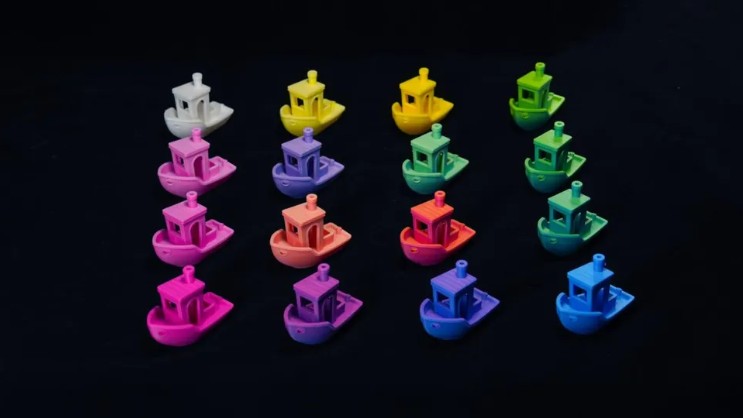
Bambu Lab has introduced a significant update to its Bambu Studio software, enabling its 3D printers to produce a wider range of colors by blending two or three filaments during a single print. Rather than relying on pre-colored materials, the new “Color Mixer Studio” feature allows users to combine existing filaments to generate new hues or smooth gradients directly on printed objects, tells Tom’s Hardware.
The approach builds on a concept similar to halftoning in traditional printing, where small variations in color placement create the illusion of entirely new shades. Instead of ink dots, Bambu’s system alternates thin layers of different filaments, tricking the eye into perceiving blended colors across a 3D surface.
While the idea of filament blending is not entirely new, Bambu acknowledges that its implementation draws from community-driven experimentation. Specifically, the company credits Ratdoux’s OrcaSlicer-FullSpectrum fork as the foundation for its color prediction system. This open-source project demonstrated how software could calculate filament ratios to approximate target colors, and Bambu has now integrated a refined version of that capability into its official ecosystem.
The update also introduces gradient printing, allowing colors to transition gradually across a model rather than appearing as discrete segments. This gives designers more creative control, enabling visually complex prints without requiring multiple dedicated filaments for each shade.
However, the feature comes with practical limitations. Achieving accurate color blending depends on precise filament control and printer configuration, and results may vary depending on geometry and material behavior. Additionally, while the system expands color possibilities, it does not fully replace the need for specialized filaments, especially for exact or highly saturated tones.
Overall, Bambu’s update reflects a broader shift in desktop 3D printing toward software-driven innovation. By leveraging algorithmic color prediction and community insights, the company is pushing consumer-grade printers closer to capabilities traditionally associated with more advanced manufacturing systems.
