

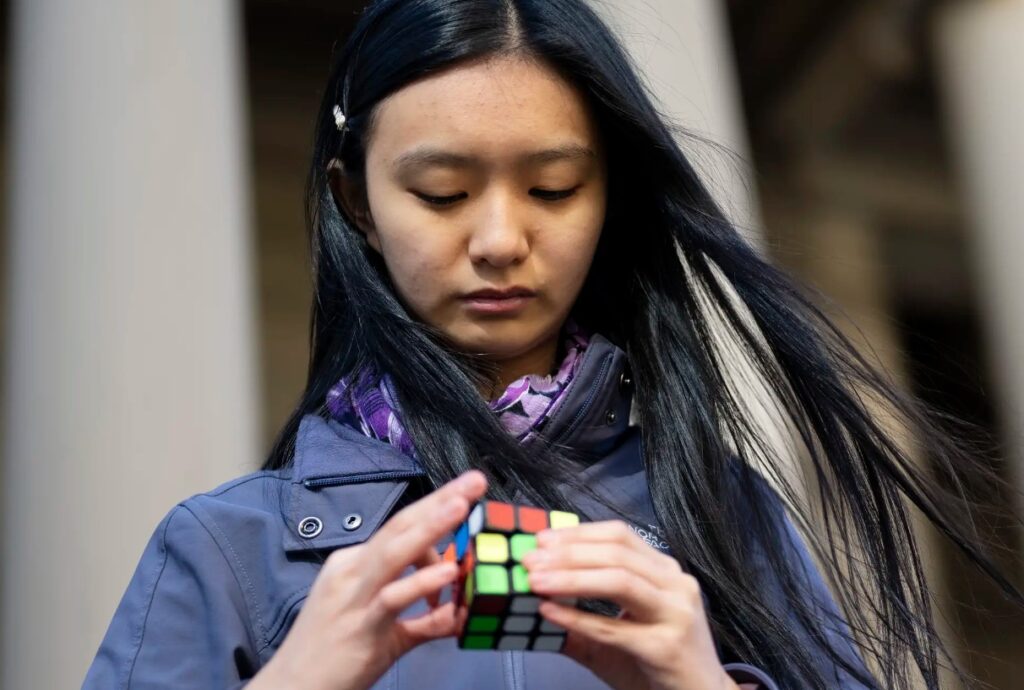
At Carnegie Mellon University, junior math major Jenny Quan is exploring the deep combinatorial structure of the Rubik’s Cube via a summer research fellowship. Rather than focusing on the fewest moves to solve the puzzle, her project tackles a less-studied question: what is the longest non-repeating path that eventually reaches the solved state? In other words, she frames the cube’s configuration space as a graph (each cube‐state a vertex, each valid twist a connection) and seeks Hamiltonian paths through that graph.
Her work began with the smaller 2×2×2 cube (about 4 million states) because the full 3×3×3 version has ~43 quintillion states and remains computationally infeasible. Leveraging the cube’s symmetries, she partitioned the configuration graph into manageable chunks and wrote code that explores paths without revisiting states. This approach draws on principles from graph theory and combinatorics, an elegant crossover of puzzle, mathematics, and computer science.
Her mentors, including doctoral research assistant Bernardo Subercaseaux and Professor John Mackey, encouraged the project when she and fellow undergrad Noah Kim approached them. One of the insights: the cube’s network is highly symmetric, meaning local move options from any given state are structurally similar. That symmetry enables clever pruning of the search.
While the ultimate ambition is to extend this method to the full 3×3×3 cube, Jenny’s results on the pocket cube already shed light on how symmetry, connectivity, and graph‐structure interact in combinatorial systems. Her research suggests that even puzzles known for speed-solving still hold rich, unexplored territory for theoretical inquiry and provide a fertile training ground for future engineers and mathematicians.
