

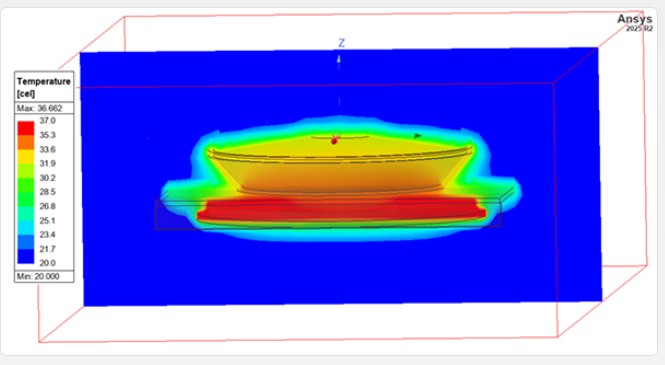
Engineers often celebrate Pi Day, March 14, by exploring creative demonstrations of mathematics and engineering. In one playful but technically meaningful example, simulation specialists used finite element analysis (FEA) to model what happens when a pie is heated in an oven. The exercise illustrates how the same computational tools used in industrial engineering can also explain everyday physical phenomena such as cooking, says Digital Engineering 24/7.
The project focused on understanding the thermal behavior of a pie during baking. Engineers constructed a digital model of the dessert and used FEA software to simulate heat transfer from the oven environment into the pie’s crust and filling. The analysis treated the pie as a system composed of multiple materials, such as crust and filling, each with distinct thermal properties that influence how heat moves through the structure.
Using these inputs, the simulation calculated temperature changes throughout the pie over time. Results showed how heat gradually travels from the outer crust toward the center of the filling. As the baking process progresses, temperature gradients develop across the pie’s cross-section, revealing which areas heat more quickly and which regions remain cooler for longer periods. These patterns are similar to those engineers analyze when evaluating heat distribution in manufactured products.
Although the scenario may appear whimsical, the underlying physics reflects real engineering challenges. FEA is widely used in industries such as aerospace, automotive, and electronics to predict how components respond to temperature, stress, and fluid flow. By modeling thermal transfer inside a pie, engineers demonstrate the versatility of simulation tools in solving both complex industrial problems and simple everyday questions.
The Pi Day experiment also highlights the educational value of simulation. Visualizing temperature fields and heat flow inside a familiar object helps explain fundamental principles of thermodynamics and computational modeling. Engineers can use similar techniques to teach students about material properties, heat conduction, and numerical analysis.
Ultimately, the pie simulation serves as a lighthearted reminder that engineering principles are embedded in daily life. From baked desserts to spacecraft components, the same mathematical frameworks govern how heat moves through materials and how engineers design systems to manage it.
