

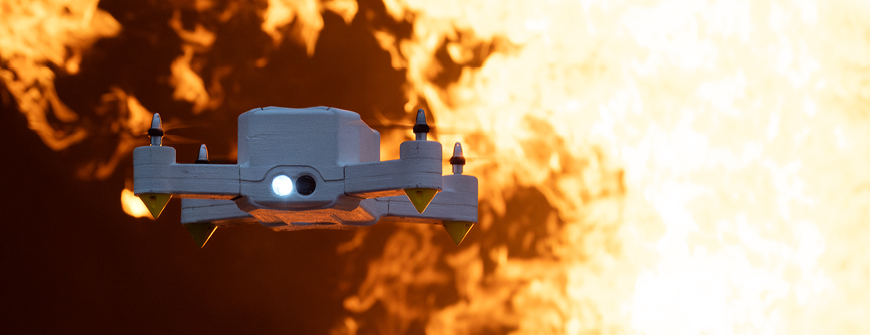
Researchers at the Swiss Federal Laboratories for Materials Science and Technology (Empa) have spun off a company to advance a drone designed to operate in environments too dangerous for humans and conventional unmanned aircraft. Called the FireDrone, this platform combines robotics with heat-resistant materials to deliver real-time situational data from extreme-temperature zones, such as burning buildings, tunnels, and industrial facilities. The goal is to give emergency responders and inspection teams the ability to assess hazards from a safe distance.
Conventional drones typically fail above roughly 40°C because frames deform and electronics overheat. The FireDrone overcomes this limitation by using patented polyimide aerogel insulation and an internal cooling system, enabling it to fly at ambient temperatures up to 200°C. That allows it to probe environments filled with toxic smoke, collapsing structures, or high heat without risking operator safety.
Onboard sensors include high-resolution infrared cameras that stream thermal images live to remote operators. This thermal feed can help locate hotspots, trapped individuals, or hazardous materials without firefighters having to enter volatile zones. The drone’s design also supports additional payloads, such as gas detectors, widening its usefulness in complex scenarios where receiving multiple data streams improves decision-making.
Another important feature is indoor operability. Since GPS signals are unreliable inside buildings or tunnels, the FireDrone is optimized with alternative localization and pilot-assistance systems to navigate without satellite-based positioning. Early testing at firefighter training centers and industrial sites has demonstrated promising capability, and future versions will include mobile docking stations that let the drone land, recharge, and relaunch autonomously.
Beyond firefighting, the FireDrone is pitched for industrial inspection in operating furnaces or chemical plants. Traditional inspections often require lengthy cool-down periods that interrupt production and incur costs. With heat-resistant flight and real-time imaging, the FireDrone could shorten downtime and reduce risk to personnel.
Developed from years of Empa research and now propelled by an Empa–EPFL spin-off team, the FireDrone represents a new class of aerial robot that brings visibility and intelligence to environments once deemed unreachable.
