

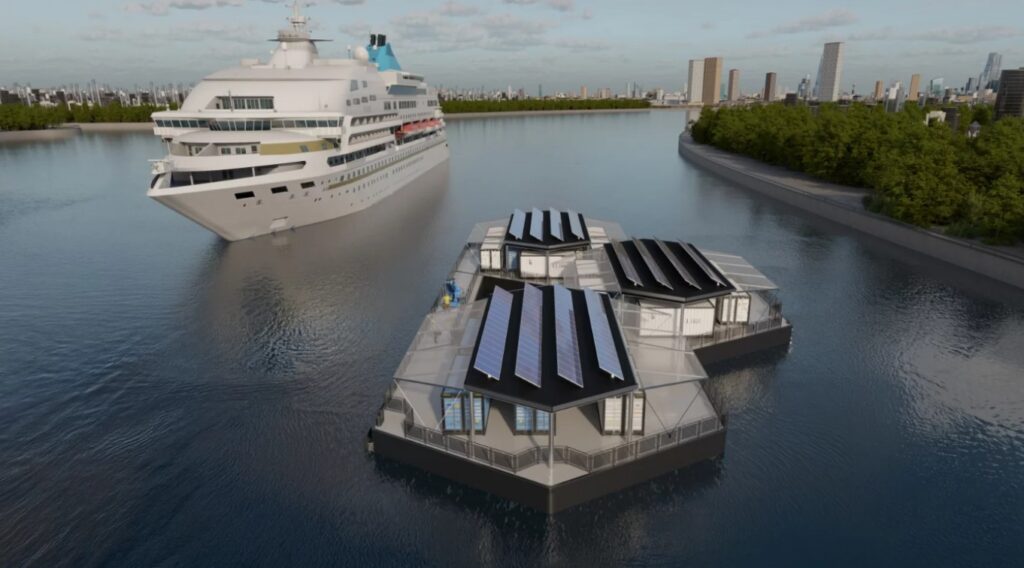
The maritime industry faces mounting pressure to reduce greenhouse gas emissions, yet supplying clean fuel to ships remains a significant challenge. A concept unveiled by Elire Group seeks to address this issue through a floating hydrogen production and refueling platform designed to operate offshore. The project, known as the Maritime Hydrogen Power Hub, combines renewable energy generation, hydrogen production, storage, and fuel distribution in a single integrated facility, tells New Atlas.
The proposed hub serves as an offshore energy station that produces green hydrogen near where it will be used. Renewable electricity generated from offshore wind turbines and solar installations powers electrolysis systems that split water into hydrogen and oxygen. The resulting hydrogen is then stored on the platform and made available for maritime applications, reducing the need for extensive fuel transportation infrastructure.
A key feature of the design is its modular approach. The platform can be deployed in strategic offshore locations and scaled according to regional energy demands. By producing hydrogen at sea, the concept aims to alleviate pressure on coastal infrastructure while creating dedicated fueling points for vessels operating along major shipping routes.
The hub is envisioned as supporting a wide range of maritime users, including cargo ships, ferries, offshore service vessels, and potentially future hydrogen-powered ships. The system could also provide clean electricity to nearby offshore operations, creating additional value beyond fuel production. Integrating generation, storage, and distribution into a single offshore installation may help improve efficiency and reduce overall operational costs.
The project reflects growing interest in hydrogen as a low-carbon maritime fuel. While battery-electric propulsion is suitable for shorter routes, hydrogen offers greater energy density and longer operating ranges, making it an attractive option for larger vessels and long-distance shipping.
Although the Maritime Hydrogen Power Hub remains a conceptual proposal, it illustrates the infrastructure that may be needed to support the maritime sector’s transition to cleaner energy sources. By bringing renewable power generation and hydrogen production directly to offshore environments, the concept presents a vision of future shipping networks powered by locally produced, low-emission fuel rather than conventional fossil energy.
