

A longstanding limitation in 3D-printed electronics has been the inability to process conductive materials without damaging the surrounding structure. A new technique developed by researchers at Rice University addresses this constraint by using focused microwaves to heat printed electronic inks during fabrication precisely. The approach redefines what can be built with additive manufacturing by enabling greater control over both material properties and device architecture, tells Tech Xplore.
Traditional electronics manufacturing relies on centralized fabrication followed by assembly, which restricts design flexibility and increases complexity. While multimaterial 3D printing promises integrated, free-form devices, it has struggled with thermal processing. Heating the inks required to make them functional often degrades or destroys temperature-sensitive substrates, limiting the range of usable materials and applications.
The new method overcomes this barrier by concentrating microwave energy into a highly localized zone, as small as the width of a human hair. This allows selective heating of the printed ink while leaving surrounding materials largely unaffected. As a result, functional electronic properties can be programmed directly into a structure during printing, even when working with delicate materials such as biopolymers or biological tissue.
At the core of the system is a device called Meta-NFS, which uses a metamaterial-inspired design to confine microwave energy in the near field. By adjusting microwave parameters, researchers can control the microstructure of printed materials, enabling significant variation in mechanical and electrical properties within a single build. This eliminates the need for switching materials or performing multiple processing steps.
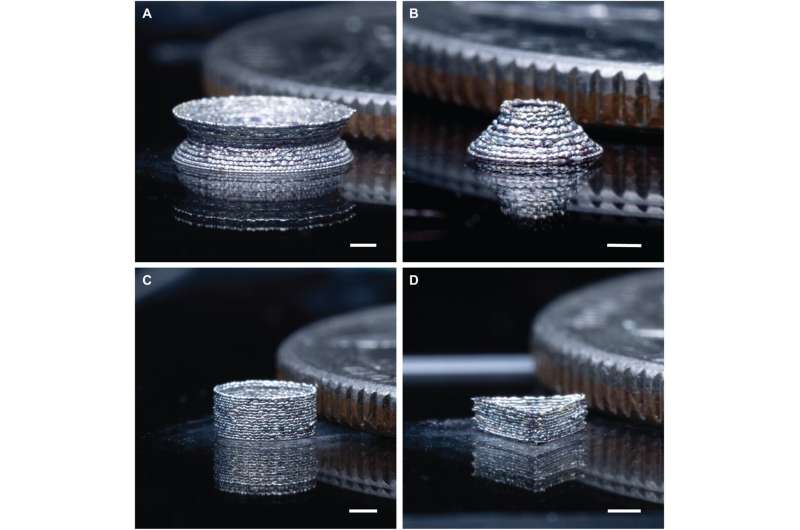
The technique supports a wide range of materials, including metals, ceramics, and polymers, and allows electronics to be embedded directly into complex structures. Demonstrations include printing sensors onto medical-grade polymers, bone, and even living plant tissue. These capabilities point toward applications such as smart implants, bio-integrated devices, and highly integrated soft robotics.
By combining precision heating with additive manufacturing, the method enables seamless, desktop-scale production of multifunctional devices. It shifts electronics fabrication from assembly-driven workflows to fully integrated design, opening the door to entirely new classes of engineered systems.
