

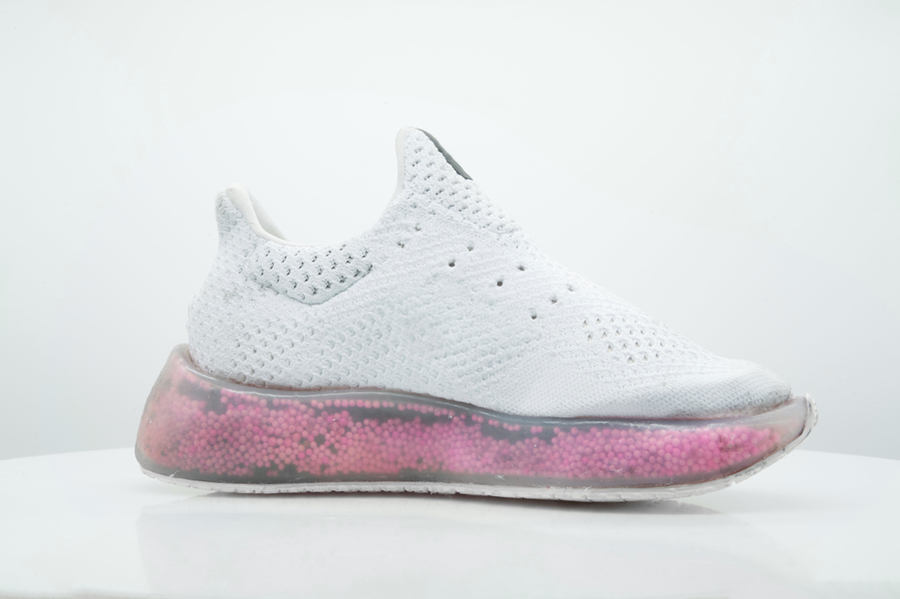
A new prototype from MIT Self-Assembly Lab reimagines running shoes as dynamic systems that improve with use rather than degrade over time. Instead of relying on fixed cushioning and stiffness, the design uses a midsole filled with particles that reorganize themselves in response to movement, creating a shoe that adapts to each runner’s unique gait, tells MIT News.
At the core of the concept is a physical phenomenon known as granular convection, sometimes called the Brazil nut effect. When a mixture of particles is repeatedly agitated, larger and softer particles rise while smaller, stiffer ones settle. In the shoe prototype, this behavior is harnessed to redistribute materials inside the midsole during running. Softer particles move toward areas experiencing higher impact, increasing cushioning, while stiffer particles shift downward to provide structural support.
This approach addresses a long-standing limitation in footwear design. Most running shoes are static, built with predefined material properties that do not change after manufacturing. Even customized shoes for elite athletes are fixed once produced. The MIT concept, by contrast, allows a single mass-produced design to evolve with the wearer, effectively delivering personalization over time without altering the manufacturing process.
The benefits extend beyond comfort. As runners train, their biomechanics and performance demands shift. A shoe that adapts can respond to these changes, maintaining optimal support and protection throughout its lifespan. This could reduce the need for multiple specialized shoes and improve performance consistency.
The research also reflects a broader trend in material design, where passive systems respond intelligently to real-world conditions without electronics or sensors. By embedding adaptability directly into the material structure, the shoe becomes a self-adjusting system driven purely by physical forces.
While still experimental, the concept points toward a future where everyday products continuously refine themselves through use. In footwear, that could mean a shift from choosing the right shoe at purchase to letting the shoe become the right one over time.
