

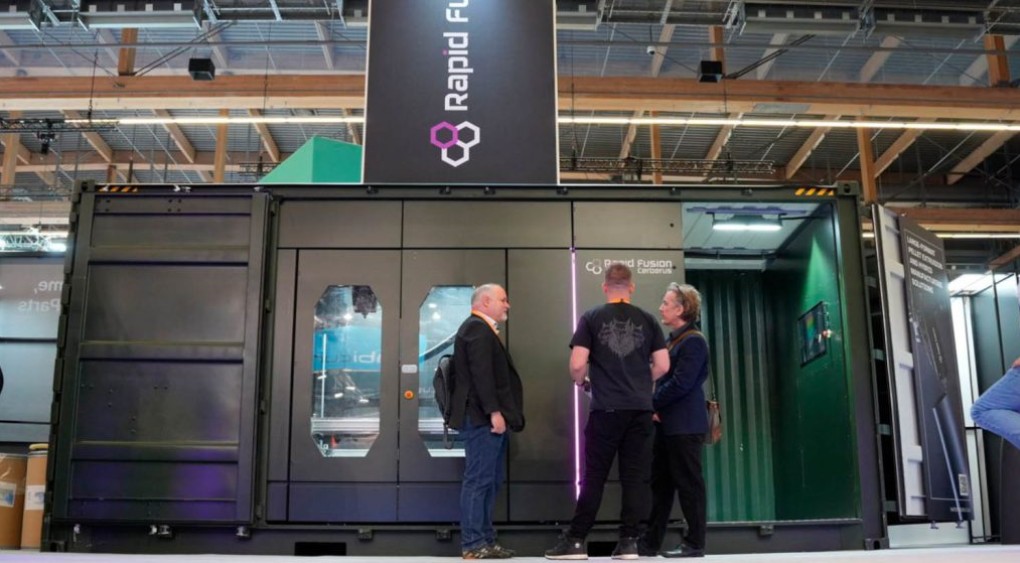
Formnext 2025 in Frankfurt underscored a shift in additive manufacturing away from broad, one-size-fits-all solutions toward purpose-built hardware, smarter software, and real-world applications. One clear theme was niche specialization, with exhibitors showing machines and materials tailored to specific tasks rather than general-purpose printers, tells Develop 3D. For example, Rapid Liquid Print’s liquid silicone system produced complex parts with smooth surfaces using highly specialized materials, and Rapid Fusion unveiled a containerized LFAM unit designed for rugged, remote field deployments that combine additive and subtractive methods. Software partners such as Dyndrite and Materialise highlighted build processors optimized to deliver better first-print results with minimal user tuning.
Another takeaway was the strong presence of compact, capable desktop machines. Companies such as Bambu Lab attracted crowds with affordable yet powerful printers, and Fibreseeker presented a continuous-fiber desktop machine at a sub-$3 000 price point. HeyGears also drew attention with its SLA technology and range of engineering resins, signaling that professional-grade capabilities are moving onto smaller, more accessible platforms. Established brands such as Formlabs and Prusa Research remained relevant with upgrades and new materials, but Asian manufacturers are rapidly gaining ground globally.
Software developments also stood out as essential enablers of adoption. Tools such as Nureo’s optimization suite made it easier to design difficult features such as conformal cooling channels, while Renishaw’s Libertas software and collaborative build processors improved quality and expanded machine utility. These developments reflect a broader industry push to make additive manufacturing easier to adopt and more predictable.
Formnext also showed that the industry’s maturity is growing. Vendors offered clearer pricing information and carbon-footprint data, and some booths focused on real user applications, from consumer products to large structural parts, rather than just hardware demos. Large-format additive manufacturing (LFAM) continued to evolve, with bigger systems and real use cases on display.
Finally, the metal printing sector highlighted the ongoing balance between speed and precision, with multi-laser systems and sensor-augmented machines competing to deliver both throughput and fine detail. Monitoring and simulation tools appeared more frequently as partners to hardware, helping manufacturers achieve quality and repeatability.
