

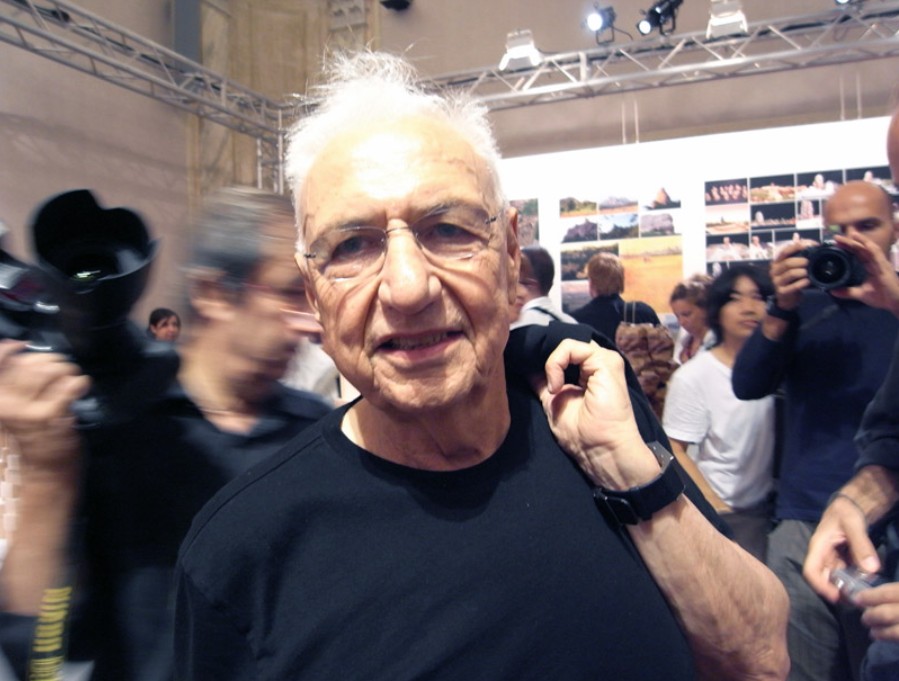
Frank Gehry, one of the most influential architects of the late 20th and early 21st centuries, has died at the age of 96. Best known for his sculptural buildings that challenged convention, Gehry transformed architecture by rejecting rigid modernism in favor of expressive, fluid forms that blurred the line between structure and art. His work redefined what cities, museums, and cultural landmarks could look like in an era dominated by steel, glass, and concrete, tells this interesting article from designboom.
Gehry rose to global prominence with the Guggenheim Museum Bilbao, completed in 1997. Its swirling titanium panels and unconventional geometry didn’t just change museum design; they transformed Bilbao itself, turning the city into an international cultural destination and giving rise to what became known as the “Bilbao effect.” The project cemented Gehry’s reputation as an architect capable of reshaping urban identity through design.
Other landmark works followed. The Walt Disney Concert Hall in Los Angeles combined dramatic stainless-steel curves with acoustical precision, becoming both a visual icon and a world-class performance venue. In Europe, the Fondation Louis Vuitton in Paris showcased Gehry’s mastery of glass, with layered, sail-like forms that appear to float within a public park. Projects such as the Dancing House in Prague and the Vitra Design Museum in Germany further demonstrated his ability to inject movement and personality into static cityscapes.
Despite his bold aesthetics, Gehry often emphasized craftsmanship, material experimentation, and collaboration with engineers. He embraced digital design tools early, using advanced modeling software to realize complex forms that were previously impossible to build at scale.
Gehry’s influence extends far beyond his buildings. He challenged architects to think more freely, to embrace risk, and to see architecture as an emotional and cultural force. As cities continue to grapple with identity, density, and sustainability, Gehry’s work remains a reminder that architecture can be daring, human, and unforgettable.
