

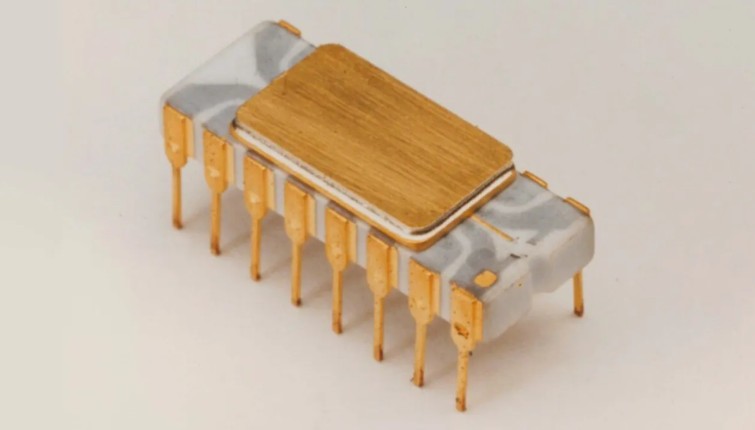
In November 1971, Intel unveiled the 4004 microprocessor, widely regarded as the world’s first commercially available single-chip CPU. Initially developed for Busicom’s calculator project, the design team recognized it had broader potential.
This Design News article tells that the 4004 was a 4-bit processor built on silicon-gate MOS technology, packing approximately 2,300 transistors and capable of addressing up to 640 bytes of memory. Intel engineer Ted Hoff, Federico Faggin, and others devised an architecture that allowed programmability, making the chip usable beyond its calculator roots.
When Intel acquired rights to expand the chip’s use beyond calculators, the 4004’s fate changed. The chip rose into general-purpose computing, powering early embedded systems before paving the way for desktops, microcontrollers, and mobile processors.
Although by modern standards its performance was modest, i.e., clock speeds under 1 MHz, limited memory, and a simple instruction set, the 4004’s real value lay in concept: an integrated, programmable processor on a single die. It transformed how engineers approached electronics, reducing complexity, cost, and size.
For engineers and tech professionals, the story of the 4004 isn’t just historical trivia. It illustrates how system-level thinking, i.e., placing processor, memory, and I/O into a coherent chipset, can enable massive downstream innovation. All today’s computing devices trace a lineage back to this modest yet monumental chip.
