

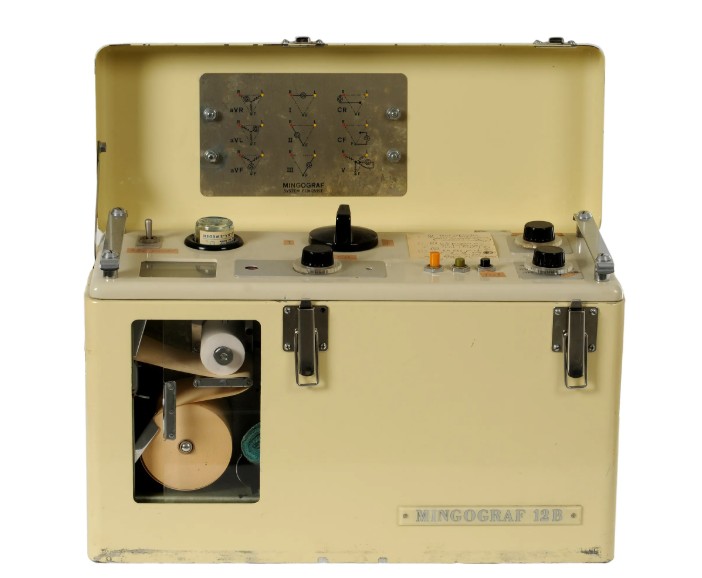
Swedish engineer Rune Elmqvist was trained as a physician, but he didn’t end up in the clinic. Instead, he leaned into engineering and made something that changed both printing and medicine. In 1949, at Sweden’s Elema-Schönander, he invented the Mingograph: the world’s first inkjet printer. It bypassed a wobbly stylus by spraying charged droplets of ink onto paper, capturing clearer ECG and EEG waveforms—and it even found its way into fields like phonetics and zoology, to record everything from speech to bird calls, tells this interesting article on IEEE Spectrum.
But that’s not the half of it. Less than a decade later, Elmqvist teamed up with cardiac surgeon Åke Senning to build the first fully implantable pacemaker. On October 8, 1958, they implanted it into Arne Larsson, thanks in large part to Larsson’s wife Else-Marie’s insistence. The first device worked for just a few hours, but the backup lasted six weeks, and ultimately, Larsson ended up living 43 more years, outliving both the inventor and surgeon.
Elmqvist’s inventions remind us how human problems take human ingenuity to solve. He wasn’t chasing commercial glory; he was solving real problems. Whether it’s smoother signal recording with inkjets or giving someone back their heartbeat, he saw a need and found a fix.
He wasn’t just a medical dropout; he was a problem-solver with a double legacy: printers that dominate home offices today, and pacemakers that save lives daily.
