

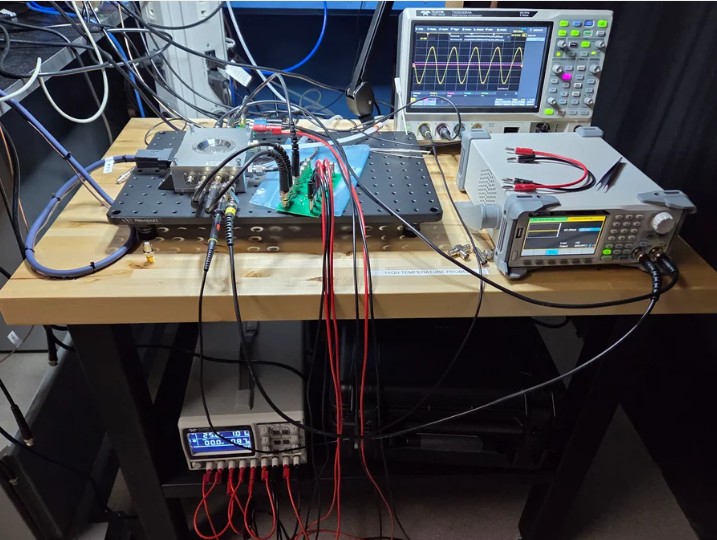
A fierce competition is heating up in the world of extreme electronics. Silicon carbide (SiC) long dominated as the go-to for high-temperature semiconductors, with operational thresholds reaching up to 600°C. That lead has now been eclipsed by a gallium nitride (GaN) rival: researchers at Pennsylvania State University, led by Professor Rongming Chu, have engineered a GaN-based high electron mobility transistor (HEMT) capable of operating at 800°C, a temperature hot enough to melt table salt, according to this IEEE Spectrum article.
The GaN HEMT achieves this by leveraging a 2D electron gas (2DEG) for fast, efficient switching, and integrating a tantalum silicide barrier to mitigate leakage and protect device integrity at extreme temperatures. While the breakthrough opens up possibilities for embedding electronics in hostile environments—such as inside jet engines, gas turbines, and even on Venus’s surface—long-term reliability remains a concern. Microfractures at temperatures above 500°C are a known issue with GaN, unlike SiC, and the current GaN devices are only stable at 800°C for around one hour.
Chu’s team is already aiming to boost performance and durability and move toward commercialization. Meanwhile, SiC isn’t stepping aside; rival labs, including that of Alan Mantooth at the University of Arkansas, are actively pushing SiC circuitry toward comparable temperature thresholds.
Why This Matters for Space Applications
- Thermal resilience: The GaN chip’s endurance at 800°C positions it as a leading candidate for electronics in environments with extreme heat—think Venus, moments of atmospheric entry, or components adjacent to hypersonic surfaces.
- Design alternatives: The widening GaN–SiC rivalry provides multiple development paths for space-grade semiconductors, giving system designers flexibility depending on reliability needs or mission duration.
