

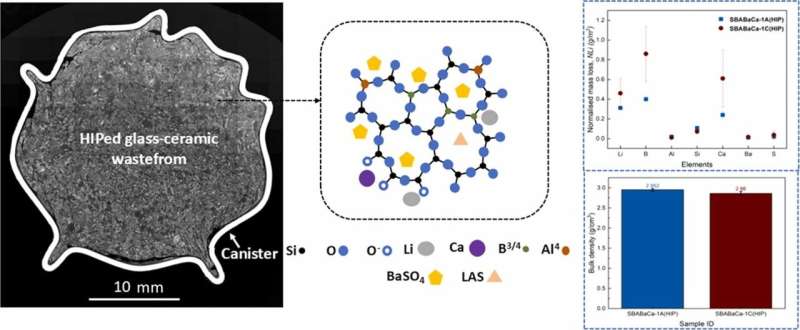
Managing sulfate-rich radioactive waste has long challenged the nuclear industry because sulfur compounds are difficult to stabilize during treatment. Conventional methods often allow sulfur to volatilize during processing, reducing wasteform quality and creating additional handling concerns. Researchers at the Australian Nuclear Science and Technology Organization (ANSTO) have now demonstrated a new glass-ceramic wasteform that overcomes these limitations, offering a promising option for the long-term disposal of these complex waste streams, tells Tech Xplore.
The research introduces a specially engineered glass-ceramic composite that locks sulfate into stable crystalline phases embedded within a glass matrix. This combination takes advantage of the chemical flexibility of glass while benefiting from the durability of ceramics. The result is a dense, low-porosity solid capable of securely immobilizing radioactive materials for extended periods.
A major innovation is the use of hot isostatic pressing (HIP) to consolidate the material. According to the researchers, this is the first successful demonstration of HIP technology for producing glass-ceramic wasteforms specifically designed for sulfate-bearing radioactive waste. The process retained sulfate during manufacturing, avoiding the sulfur losses and off-gas generation that commonly complicate treatment.
The project originated from ANSTO’s need to manage sulfate-containing liquid waste produced during medical radioisotope manufacturing. However, its relevance extends well beyond Australia. Sulfate-rich radioactive waste is generated worldwide through nuclear fuel processing, facility decontamination, and the cleanup of legacy nuclear sites, making the technology potentially valuable for international waste management programs.
The team also evaluated interactions between the wasteform and its stainless-steel storage canister. Testing found minimal chemical interaction and no evidence that either the wasteform’s performance or the canister’s integrity would be compromised over time.
Although further optimization, scale-up, and engineering work remain before commercial deployment, the study provides a strong foundation for future waste treatment systems. Building on ANSTO’s Synroc technology, the research represents a meaningful advance in developing safer, more durable methods for the long-term immobilization of sulfate-rich radioactive waste while supporting the continued production of medical radioisotopes.
