

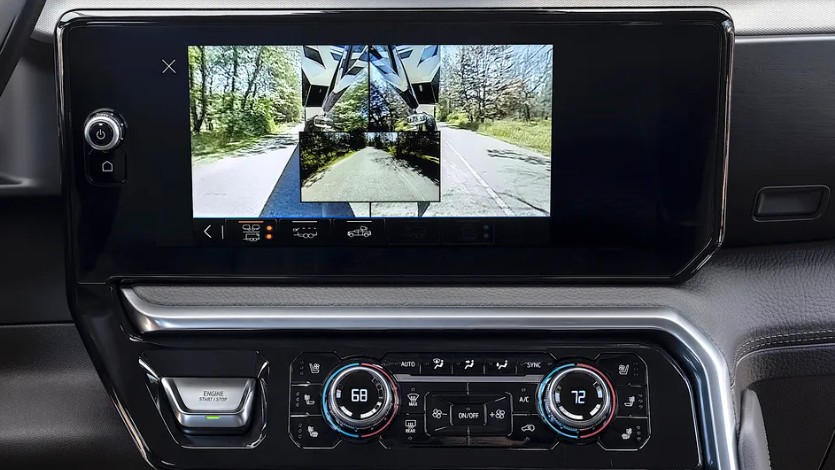
General Motors engineers are offering a rare technical look into the advanced camera systems powering the company’s surround-view and transparent trailer technologies, revealing the extraordinary engineering precision required to make large trailers appear nearly invisible to drivers. A report from Design News explains how GM combines computer vision, geometric reconstruction, calibration systems, and real-time image processing to create stable composite views while towing.
The transparent trailer feature blends images from multiple cameras mounted on both the truck and trailer to simulate an unobstructed rearward view. While the final display appears simple to drivers, the underlying system must constantly calculate camera orientation, vehicle geometry, trailer articulation angles, and environmental motion in real time. Even slight calibration errors can disrupt the illusion. GM engineers noted that a deviation of just 0.1 degrees in camera positioning can create visible distortions because the cameras function not merely as image sensors but as geometric measurement devices.
One of the biggest obstacles comes from folding side mirrors. According to GM’s software engineering team, folding mirrors rarely return to precisely the same position after movement or accidental impacts. That variability complicates camera alignment because the system depends on exact knowledge of every camera’s orientation relative to the vehicle and trailer.
The system also requires accurate tracking of trailer articulation angles, the constantly changing relationship between the towing vehicle and trailer during turns. GM uses a combination of mathematical modeling and deep neural networks to estimate these angles and maintain proper image stitching. The software reconstructs hidden regions by projecting camera pixels into a synthetic three-dimensional geometry that maps the surrounding environment.
Another challenge involves scalability. GM must adapt the same core algorithms across multiple vehicle models, trailer sizes, and camera configurations while maintaining consistent image quality and low processing latency. The company designed the software architecture to remain camera-location agnostic, allowing features to be reused across platforms without rebuilding the entire system for each vehicle.
The technology reflects the growing convergence of automotive engineering, computer vision, and artificial intelligence. Features once considered futuristic driver-assistance tools increasingly depend on sophisticated spatial computation operating continuously behind the scenes. GM’s transparent trailer system demonstrates that modern automotive safety and convenience technologies are becoming as much about software precision as mechanical engineering.
