

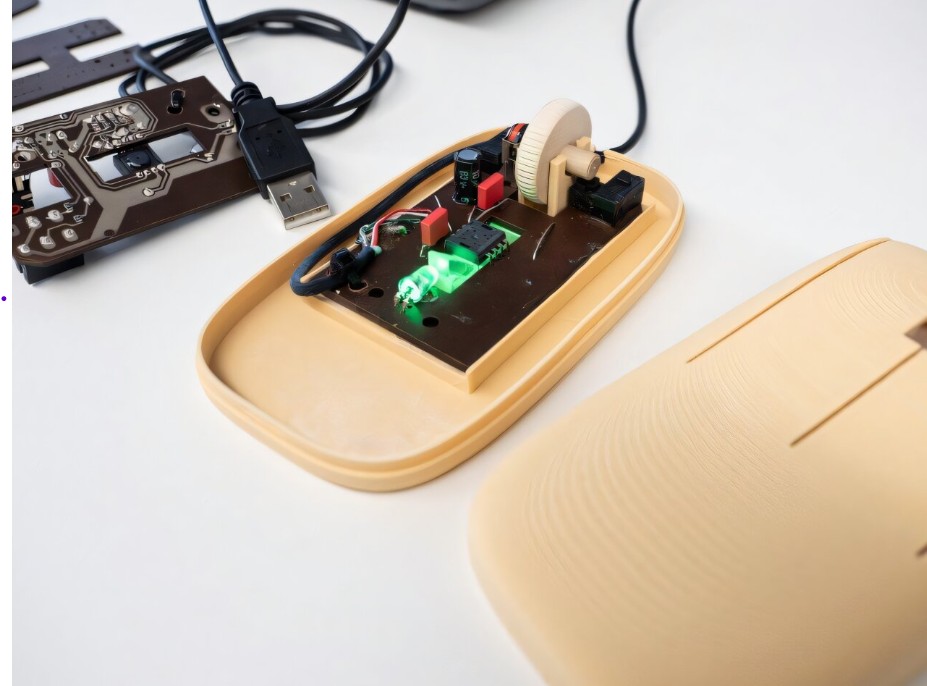
Printed circuit boards (PCBs) are central to nearly all electronic devices. Yet the traditional substrate, fiber-reinforced epoxy resin, is petroleum-based, hard to recycle, and often discarded in landfills or burned under harsh conditions. The waste and environmental toll are significant. Empa’s team, under the EU project HyPELignum, proposed an alternative: a wood-based, fully biodegradable substrate derived from lignocellulose, normally treated as waste after wood processing, tells Tech Xplore.
To create this substrate, they convert lignocellulose into fine networks of fibrils via a process called hornification, i.e., drying under pressure to bind the fibrous matrix. The residual lignin acts as a natural binder. The resulting boards can conduct electricity when printed with copper traces and house electronic components. Empa’s team integrated these into working devices such as a computer mouse and RFID cards.
Performance is almost on par with conventional PCBs, though the new boards remain more vulnerable to moisture. That sensitivity is in part by design: to enable biodegradation, microorganisms must access water to decompose the substrate. The challenge now is to improve moisture resistance without undermining compostability.
At the end of life, the board’s organic substrate can compost under suitable conditions, while the metal components (traces, chips) can be reclaimed and recycled. The researchers emphasize that many electronic devices are used for just a few years, making long-lasting, nondegradable materials less justifiable.
Looking ahead, the goal is to refine the material’s durability, expand demonstration devices, and push for industrial uptake. As part of HyPELignum, the team hopes to deliver more applications by 2026 and collaborate with European firms to bring biodegradable electronics to market.
This work could shift how we think of electronics: not as permanent objects, but as transient tools whose physical bodies return to nature once their function ends.
