

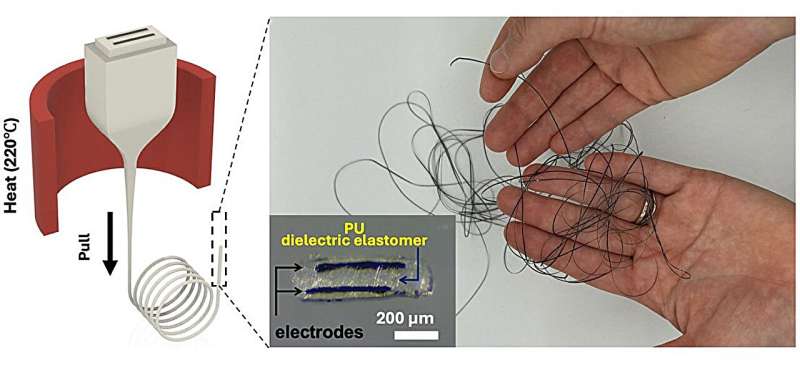
Researchers at Tohoku University, working with collaborators in France, have developed an ultrathin actuator fiber capable of producing complex motion when stimulated by electricity. The device, described as a “soft yarn” actuator, is as thin as a human hair yet can bend, contract, and perform three-dimensional movements. The innovation offers a new approach to building flexible robotic systems designed to interact safely with humans, tells Tech Xplore.
Soft actuators are materials that convert electrical energy into mechanical motion and form a core component of emerging technologies such as soft robotics, wearable assistive devices, and biomedical tools. Conventional actuators often rely on metallic materials such as shape-memory alloys. Although effective, these materials are typically rigid and can require complicated activation methods involving heating or magnetic fields. Such limitations make them less suitable for applications where flexibility and gentle interaction with the human body are essential.
To overcome these challenges, the research team created the actuator using a flexible polymer fiber fabricated through thermal drawing, a manufacturing process that produces extremely thin fibers with embedded functional structures. When an electrical current passes through the fiber, it generates controlled mechanical motion. The actuator can bend, shorten, or change shape depending on how the electrical stimulus is applied, allowing it to produce complex movements despite its microscopic size.
The softness and compliance of the material make it particularly attractive for systems that operate close to people. Because the fiber lacks rigid components, it can generate motion without creating the discomfort or safety concerns associated with hard mechanical devices. Potential uses include wearable robotics that assist movement, flexible medical tools, and soft robotic systems capable of delicate manipulation.
Researchers believe the technology could eventually enable new forms of textile-like robotic structures in which multiple actuator fibers are woven together to create responsive materials. Such fabrics could contract, bend, or change shape dynamically in response to electrical signals.
Although still in the early stages of development, the hair-thin actuator demonstrates how advances in materials science and microfabrication are reshaping the design of robotic systems. By combining extreme flexibility with electrically driven motion, the “soft yarn” actuator points toward a future where robotic functionality can be integrated directly into lightweight fibers and fabrics.
