

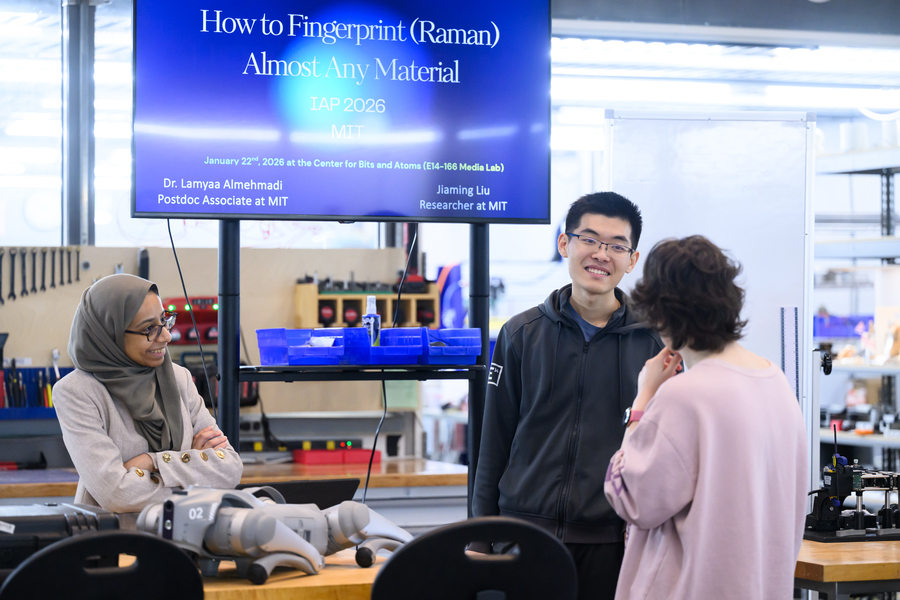
A recent workshop at Massachusetts Institute of Technology introduced participants to the practical power of Raman spectroscopy, turning an advanced analytical technique into an accessible, hands-on experience. The MIT News article describes how students, researchers, and staff explored this laser-based method for identifying materials across a wide range of applications.
Led by postdoctoral researcher Lamyaa Almehmadi in collaboration with the Center for Bits and Atoms, the workshop focused on Raman spectroscopy’s ability to “fingerprint” materials by analyzing how laser light scatters when it interacts with molecular structures. Participants used handheld devices to examine everyday objects, from cosmetics to stones and food, observing how each produced a distinct spectral signature.
The session emphasized both the science and the accessibility of the technology. Once limited by weak signals and bulky equipment, Raman spectroscopy has evolved through advances in lasers, computing, and miniaturized optics. Modern portable devices can now identify materials within seconds by comparing spectral data against extensive digital libraries.
A standout demonstration featured a robotic dog equipped with a Raman sensor, illustrating how the technique can be deployed remotely in hazardous environments such as crime scenes or industrial sites. Participants controlled the robot and observed real-time analysis, highlighting the growing convergence of robotics and chemical sensing.
The workshop also showcased the breadth of Raman spectroscopy’s applications, including detecting explosives and narcotics, authenticating gemstones, verifying pharmaceutical ingredients, and supporting research in advanced materials. Because the method is non-destructive, it is especially valuable in fields where preserving samples is critical.
Beyond technical instruction, the program encouraged creative thinking about future uses, from environmental monitoring to energy systems and medical diagnostics. By combining theory with hands-on experimentation, the workshop demonstrated how emerging tools can move from specialized labs into broader, real-world use, empowering a wider community to engage with advanced materials analysis.
