

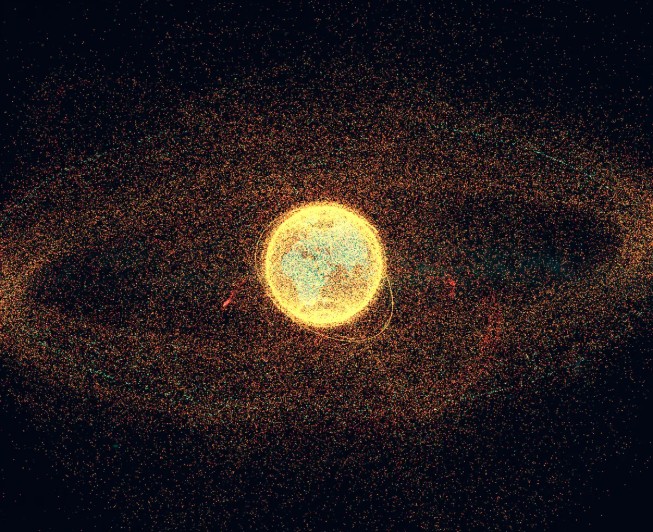
The orbital environment around Earth is becoming a battlefield of debris. What started as scattered remains of defunct satellites and exploded rocket parts has escalated into a potentially self-sustaining cascade of collisions. At speeds many times faster than a bullet, even millimeter-sized fragments can punch holes in spacecraft, tells IEEE Spectrum.
Satellite operators now live with constant alerts. SpaceX’s Starlink system alone executed over 144,000 collision-avoidance maneuvers in the first half of 2025, three times more than in the prior six months. While that capability demonstrates agility, it also underscores a bitter reality: we may already be edging into a zone where dodging won’t be enough.
The concept at play is the Kessler syndrome, proposed in the 1970s: once debris reaches a critical density, collisions will spawn more debris, triggering an exponential chain reaction. Researchers now believe parts of low Earth orbit, especially altitudes between 400 and 1,000 km, are at or near that threshold.
The complexity goes beyond just tracking. Most debris is too small to detect reliably, and collisions can vault fragments into unexpected orbits, complicating hazard maps. That fog demands smarter systems. AI and machine learning are being deployed to improve detection, issue faster collision warnings, and optimize satellite maneuvers.
Still, AI is only part of the answer. To truly turn the tide, Earth’s stewards must clean up existing junk. Technologies are emerging—robotic “grabbers,” de-orbiting satellites, and mission plans to guide debris into safe reentry corridors.
Laws need rewriting too. Current treaties often tether ownership to objects (even fragments), hampering removal efforts. Experts argue for globally coordinated orbit management, akin to air traffic control. Shared “carrying capacity” models could limit how many satellites each player may place in a given orbit, with governance that balances growth and safety.
If we fail, some orbits may become unusable. Space, once the ultimate frontier, could turn into a locked zone of danger. The challenge now is not just managing traffic up there; it’s redesigning our rules for how we live and build in Earth’s much larger second home.
