

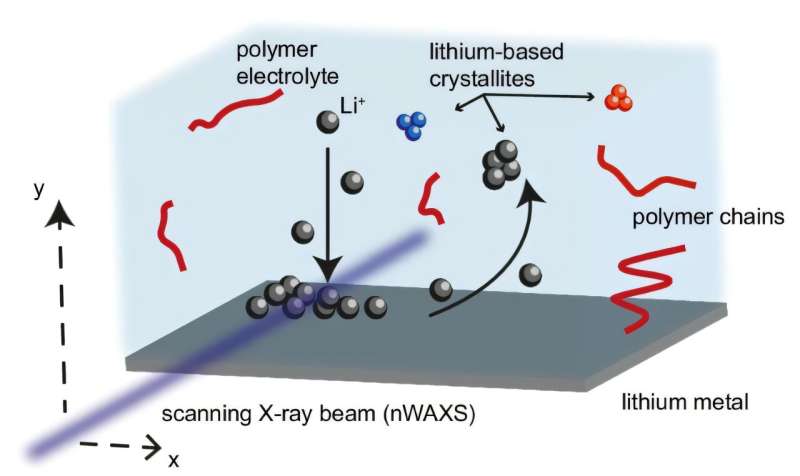
Advances in lithium-metal batteries promise lighter, higher-energy storage solutions for electric vehicles, grid systems, and portable electronics. But a new study from Technical University Munich (TUM) uncovers a serious safety concern: polymer-based solid electrolytes, once considered a safeguard against short circuits, can themselves host needle-like lithium dendrites deep within their bulk, tells Tech Xplore.
Traditionally, efforts to suppress dendrite growth have focused on the interface between electrode and electrolyte, under the assumption that dendrites originate there. This research challenges that view. Using nanofocus wide-angle X-ray scattering at German Electron Synchrotron (DESY), the team captured real-time imaging of dendrite formation inside a polymer electrolyte during battery operation. The beam diameter was just 350 nm, and the setup mimicked real battery conditions.
Key findings include:
- Dendrite crystallization was observed within the electrolyte’s interior, not merely at its surface interface.
- This internal crystallization undermines the presumed safety advantage of polymer electrolytes over liquid types. The insights suggest that material engineers must rethink electrolyte design, focusing on suppressing internal growth pathways, not just surface stability.
The implications are significant for the battery industry. If dendrites grow unseen inside electrolytes, even cells labeled “solid-state” may still face latent internal failure modes. Addressing this risk is critical to realizing the promise of high-energy lithium-metal cells with safe cycle life and long-term durability. The study opens a pathway toward next-generation electrolytes engineered to block dendrite initiation throughout their volume, not just at interfaces.
Battery manufacturers and research labs will need to update design assumptions and validation tests to include internal monitoring of dendrite behavior, not just surface or interfacial diagnostics.
