

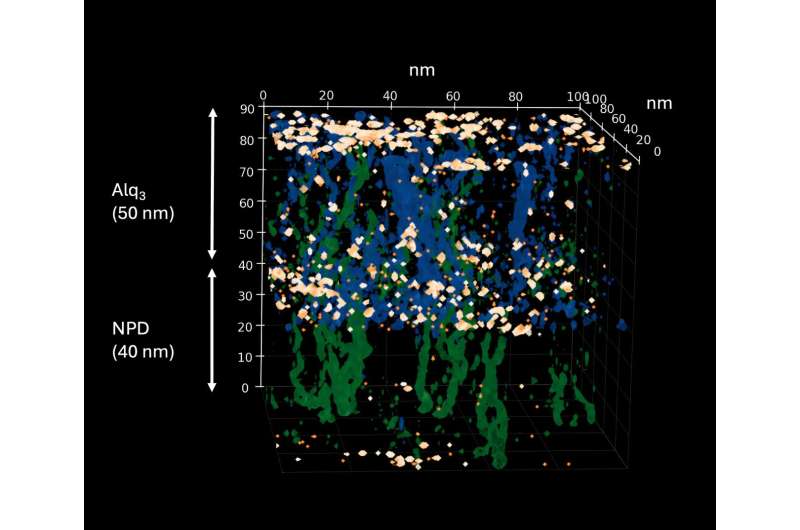
While OLED pixels appear to emit light uniformly, researchers at the University of Michigan found that light actually originates from tiny, localized hotspots at the nanoscale. The Tech Xplore article uncovers a fundamental issue in organic light-emitting diode (OLED) technology, widely used in smartphones, televisions, and other displays.
These hotspots form due to uneven current distribution within the organic material. Instead of spreading evenly, charge carriers such as electrons and holes travel along preferred low-energy pathways, concentrating into narrow channels. This phenomenon, often described as current channeling, creates regions where significantly more electrical stress occurs.
The consequence is accelerated degradation. Areas carrying higher current densities are more likely to overheat and fail earlier, reducing the overall lifespan of the device. Even though users perceive a stable and uniform display, microscopic flickering and localized intensity variations may be taking place beneath the surface.
The findings challenge long-held assumptions about OLED operation, where emission was typically treated as spatially uniform. Instead, the research reveals a complex internal landscape that directly affects performance and reliability. The implications extend beyond displays. Similar charge transport behavior exists in other organic electronic systems, including solar cells and transistors, where uneven current flow can limit efficiency and durability.
To address this issue, the researchers suggest rethinking material structure. Conventional OLEDs use amorphous organic layers, but introducing more ordered, crystalline structures could help distribute current more evenly, potentially extending device lifetimes.
The study highlights a broader engineering challenge: as electronic devices shrink and performance demands increase, nanoscale effects play a growing role in determining reliability. What appears smooth and uniform at the macroscopic level may conceal complex behaviors at smaller scales.
By revealing the presence and impact of nanoscale hotspots, the research offers both a warning and an opportunity. Understanding these hidden mechanisms could lead to longer-lasting, more efficient OLED devices and improved performance across a wide range of organic electronics.
