

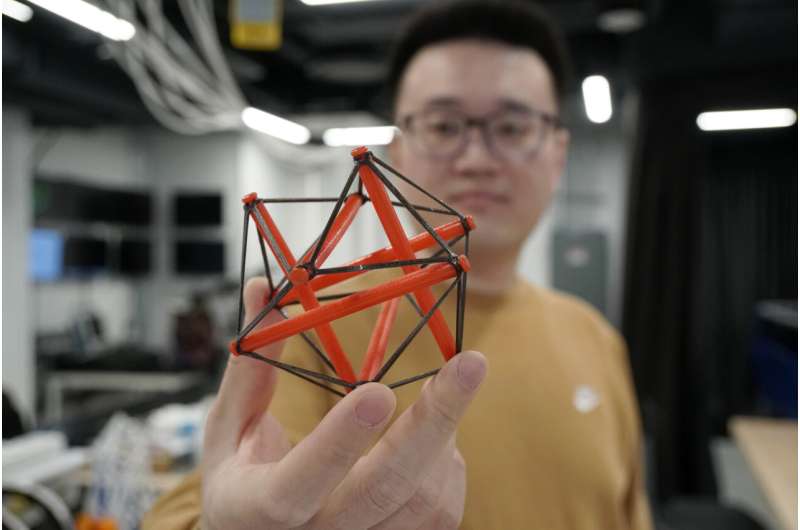
A recent study highlighted by Tech Xplore reveals a surprising mathematical connection that could transform how engineers design complex structures. Researchers at Princeton University have uncovered a unifying theory that links two seemingly distinct fields: origami, the study of folding surfaces, and tensegrity, which focuses on structures stabilized through a balance of tension and compression.
The breakthrough addresses a long-standing challenge in engineering. While simple, symmetrical shapes such as cubes or spheres are relatively easy to model, irregular forms found in nature, like termite mounds or bone structures, are far more difficult to describe mathematically. These systems typically require large sets of variables and complex equations, making them impractical for efficient design.
The researchers’ solution lies in what they call “invariant dual mechanics.” This concept allows engineers to begin with a well-understood symmetric structure and transform it into a more complex, irregular form while preserving key mechanical properties such as stability or flexibility. Because these properties remain invariant, designers can avoid recalculating them from scratch for every new configuration.
This approach significantly reduces computational effort and opens new possibilities for optimization. Engineers can rapidly explore variations of a design, fine-tuning performance without relying on trial-and-error methods. The framework is especially valuable in fields where geometry directly determines function, including robotics and metamaterials.
Beyond its technical implications, the work reflects a broader trend in engineering: drawing inspiration from natural systems. By capturing the underlying mathematical principles that govern complex forms in nature, researchers are enabling more efficient and adaptable designs.
Ultimately, the study demonstrates that even highly irregular structures can be understood through elegant mathematical relationships. By bridging disciplines, it offers a powerful new tool for engineers seeking to design structures that are both complex and predictable, combining creativity with computational efficiency.
