

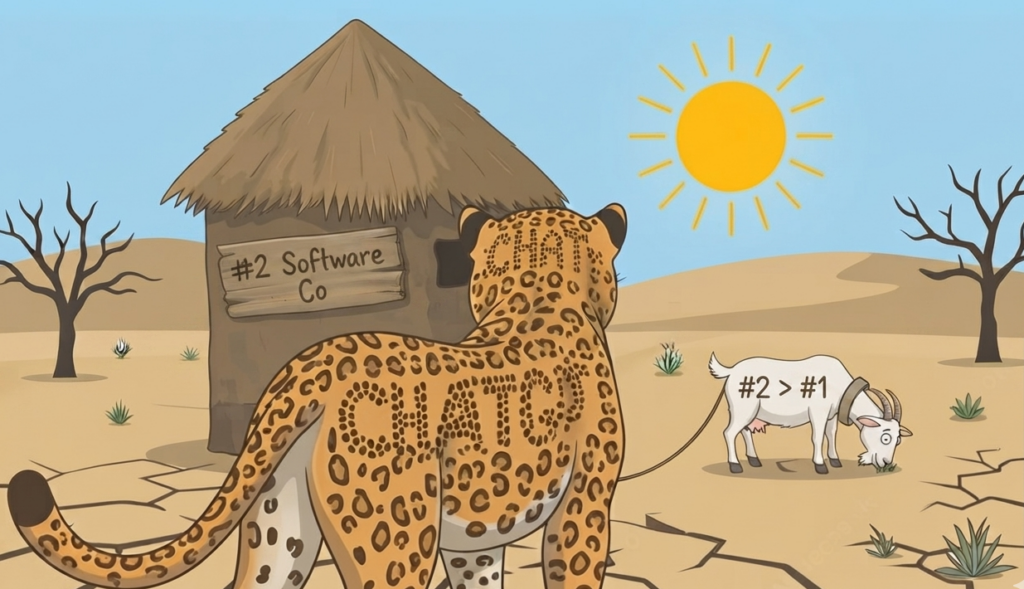
 Ask ChatGPT which CAD package a hardware startup should buy. Ask Gemini. Ask Claude or Perplexity while you’re at it. In seconds, you’ll get a neat, confident recommendation with all the authority of someone who knows it all. The answer engine, chatbot, LLM, AI…whatever you call it, has, after all, digested all the information it could access online.
Sometimes the answer engine will reveal its sources. Usually not. Few of us will ask for its sources.
The rate at which people are putting questions to answer engines is growing exponentially, while the use of plain old regular search is on a decline. The inflection, the point at which answer engines pass search engines, could happen in 2028, according to Growth Engines.
While Google still fields the overwhelming majority of the world’s questions, ChatGPT has leaped to a 17% share. It’s the first time since Google took over search that anything has threatened its dominance.
It’s yet another existential crisis for publishers and analysts. After all, they also attempt to digest all the information available and provide answers.
Zero Clicks. People Are Not Clicking
When Google puts an AI-generated summary at the top of a search results page, only about 8% of visits produce a click to a traditional link, compared to almost twice that rate (15%) when there is no summary (Pew Research Center, July 2025). Barely 1% of users click a link inside the AI summary itself. Even before AI overviews scaled, most U.S. searches already ended with no click to source. (SparkToro, 2024).
So the answer engine reads whatever it can find, repackages it into a paragraph, and sends almost nobody back to the source for more information.
Damn, that’s cold, say publishers.
Can You Trust ChatGPT? Gemini?
Are the answer engines reliable? That depends.
The material answer engines’ source material runs the gamut of credibility — from anonymous Reddit ranting to more authoritative Wikipedia, all the way to peer-reviewed journals, at least those that have not been walled off. The chatbots (essentially what search engines are) blend it and distill it into a paragraph or two.
Normally, you cannot tell what the answer is based on. If you ask it what the best CAD program is, for example, is the answer based on rigorous benchmarks? I doubt it. Is it based on a five-year-old forum thread posted by someone who tried the trial version and gave up? Maybe. Is the answer based on a biased comparative review found on a CAD vendor’s site? Often so. More on that later.
Who is getting rich from all this AI use? Reddit, upon realizing that its threads were quite often the basis of answers from answer engines, now licenses its archive to Google and OpenAI. When Anthropic — the company behind Claude — kept scraping without signing a deal, Reddit sued, alleging the site had been harvested more than 100,000 times without permission. (Reddit, Inc. v. Anthropic, PBC, California Superior Court, June 4 2025).
How long before other gardens of data, tired of being plundered, all start to charge admission?
Another Beat-down for Poor Publishers
It’s déjà vu all over again. That’s Yogi Berra reacting to back-to-back homers by Roger Maris and Mickey Mantle in 1961. It works for publishers, too.
It’s been a tough slog for publishers. First, online media practically killed print media. Then came Google, which leapfrogged the entire media industry to become the largest advertising platform ever. Ouch.
Google was just a search engine. How did it eat our lunch, we wondered.

The survivors leaned harder on sponsored content and vendor-supplied articles, only to lose even more readers as trust eroded. Lower trust, lower readership. Vultures circled overhead. Survivors eke out an existence in quiet desperation.
As they cling to life, publishers survive on handouts. The same giant that stole their lunch sends them traffic. At engineering.com, we got more article views from Google than from our own home page. Google accounted for 40% of of our traffic.
But when ChatGPT burst onto the scene, the walls closed in some more. ChatGPT was not doling out any links. Sure, you could ask it for links to sources, but no one bothered.
Zero clicks is the almost the rule with answers from ChatGPT. Same with the other LLMs.
Google, once the widest road for website traffic, is now just a dirt path.
Marketers Are Befuddled
So how is a marketer supposed to deploy a budget in this new world? Buy ads on publications with no traffic and no trust? Bet on the sites the engines seem to favor, hoping that someone asks for a link?
Nobody, it seemed, had an answer.
Enter Super Marketer, Ron Close
Ron Close, who has held high-level marketing roles at design and engineering software companies, including DS SolidWorks, wanted to know who and what the answer engines were favoring when they developed an answer. Perhaps it would lead to the oasis in the desert. Which sources do they cite, when they do actually cite, when asked a real engineering-software question? He went looking for prior research on the subject. He found nothing. He decided to do his own research. The result is three separate reports:
- AI Engine Optimization in CAD Software, a 50-prompt analysis of CAD vendor visibility across ChatGPT and Google Gemini, March 2026
- AI Engine Optimization in Manufacturing, a 50-prompt analysis of MES vendor visibility across ChatGPT and Google Gemini, March, 2026
- AEO for B2B Marketers, answer engine optimization, a practical guide to AI visibility strategy, June 17, 2026
Ron expected the answer engines to learn from those he and others in the industry had learned from: engineering.com for MCAD, DEVELOP3D for CAD AEC, the respected industry analysts — Jim Brown of Tech-Clarity, Chad Jackson of Lifecycle Insights, Monica Schnitger…
But their presence was conspicuously absent.
What Are Chatbots Learning From?
Across 100 AI responses to those 50 CAD prompts, the trade press was cited almost never. Industry analysts fared only slightly better. These fonts of knowledge were not being tapped.
What was tapped?
- Vendor websites
- Resellers — GoEngineer, TriMech, cadsoftusa.com.
- A manufacturing service
Head-to-head comparisons were gobbled up and regurgitated. We know and expect vendors to list advantages of their own products over the competition’s. We know comparisons on sites run by businesses with a vested interest in products cannot be deemed reliable. Answer engines, apparently do not know.
Xometry, a manufacturing service, was cited most often by ChatGPT in the CAD study, appearing in 11 of 50 responses.
Reddit was cited most often by Gemini.
SolidWorks appeared in 76% of ChatGPT responses and 72% of Gemini’s. SolidWorks is the unquestioned recommendation for design software, regardless of the prompt. Onshape, the leading cloud-based challenger to SolidWorks, was in 40% of Gemini’s responses but only in 22% of ChatGPT’s.
Nearly all Onshape mentions stemmed from buyers requesting a comparison between Onshape and SolidWorks. Ask any answer engine an open-ended question, though, and SolidWorks was the unequivocal winner.
The two engines studied (ChatGPT and Gemini) behaved differently in other ways, too. In the MES study, ChatGPT would cite no sources at all, while Gemini cited sources 94% of the time. In the CAD study, ChatGPT cited its sources 58% of the time, while Gemini did so 82% of the time.
Across the hundred CAD responses, the engines named more than 216 distinct products — not just CAD tools but the simulation, PDM, PLM, CAM and rendering software. This may be due to chatbots not understanding the distinctions between design and engineering software categories.
Honestly, can we even expect them to know the nuances of nomenclature in our industry, the differences between PDM and PLM, for example?
Ask a chatbot “What tools do robotics engineers use?” How would it know you want to create the software, systems and controls, source the actuators, or study the range of motion?
Feeding the Beast
The core of Answer Engine Optimization (AEO), according to Ron: place content where answer engines will find it. If the answer engines favor comparison content, publish comparison content. Put a detailed “[Your Product] vs. SolidWorks” page on your own domain, structure it for easy parsing, and let the answer engines find it.
Ron’s research proves comparison review work. Data show that vendor-authored comparisons are cited as though they were neutral third-party reviews.
That is hardly the entire playbook. Ron also suggests that marketers build glossary hubs, which serve as easily digestible fodder for answer engines. Write questions in titles and answers in tight 40-to-60-word blocks. Summarize analyst briefings…
It makes sense for the most part. It is the comparison-content recommendation where I start to fidget.
A comparison of competing products, hosted on one of those products’ own websites, is suspect. It is the home team officiating and scoring the game. The home team will not mention their players’ weaknesses, only their strengths. Inconvenient truths will not come up. The home team will always win.
Leopard Eyes the Goat
Reliable content is getting harder for the answer engines to access. Content generators have learned to protect their content with paywalls and licensing fees. The New York Times and The Wall Street Journal, bastions of original, quality reporting, for example. Peer-reviewed journals in science and medicine supply original research. LinkedIn lists millions of professionals and hosts a vast amount of content they generate. It forbids “scraping” by answer engines. Listing sites like Zillow (real estate) and review sites like OpenTable (restaurants) deny access to site-crawling bots, including those by Google. Reddit has sued Anthropic, makers of Claude, for violating its terms of service.
As access to quality content shrinks, the chatbots eye self-published vendor comparisons as a leopard may eye a tied-up goat. Easy prey.
Chatbots falling for the trap of self-published comparisons may just be too tempting to ignore. Certainly, there is a paucity of comparisons by independent judges. There are no more contests for CAD software, no more product roundups. Comparisons can only have one winner, and everybody else is a loser. Every parent thinks their baby the prettiest, so they pull their support. Neither the industry media nor industry analysts can afford that to happen.
Window of Opportunity. Enjoy While It Lasts
Clearly, Ron has identified a window wide open.
But for how long? The answer engines are sure to realize that presenting obviously biased information as fact is just stupid. They will wake up one morning, come to their senses, stop believing vendors praising their own products, and flip a switch. Just as Google stays one step ahead of “search engine optimizers” who try to game the search results, we can expect answer engines to discount or even ban the sites that bait them.
Until then, marketers go crazy. Enjoy the easy pickings. Your companies will certainly benefit from comparative reviews published on your sites in the short term. You’re certain to pick off a few shoppers looking for alternatives to their software, whose only research is a ChatGPT query.
But be ready. Start developing a long-term strategy. Answer engines are here to stay. They are getting smarter by the day. They will no doubt find reputable and reliable sources of information…
Which reminds me: I have a a little project to finish.
