

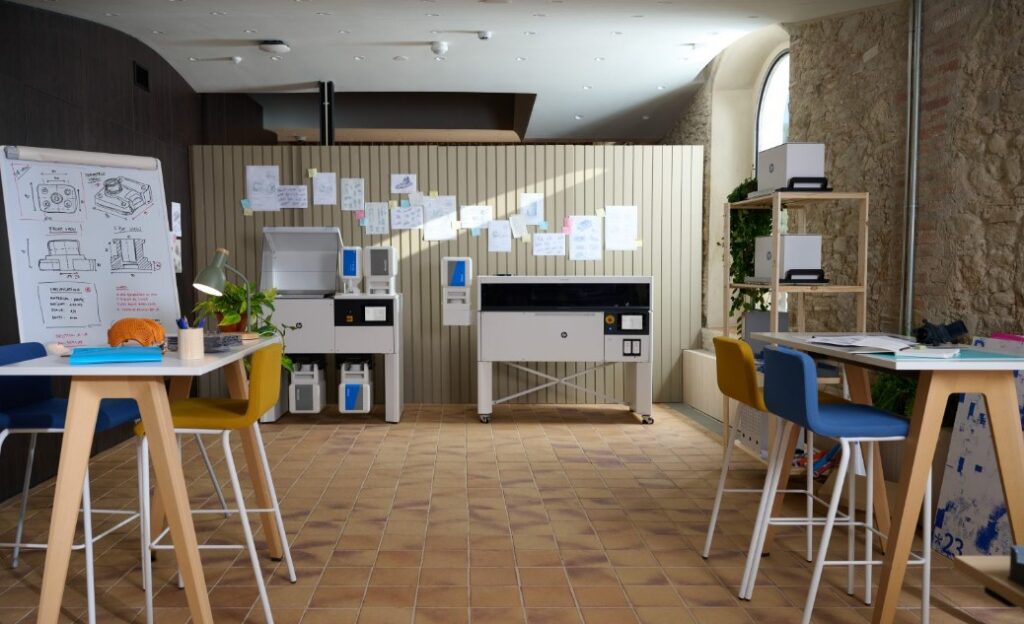
An article published by 3D Printing Industry blog examines HP’s latest effort to make industrial-grade additive manufacturing more accessible within everyday engineering environments. The company’s new solutions are designed to shrink the gap between large-scale industrial production systems and smaller in-house engineering workflows, allowing teams to prototype and iterate faster without relying entirely on centralized manufacturing facilities.
At the center of the announcement is HP’s effort to reposition industrial 3D printing as a practical engineering tool rather than a specialized production technology isolated inside dedicated manufacturing departments. The company is emphasizing compact systems capable of delivering functional prototypes, tooling components, and end-use parts while fitting more naturally into office and engineering studio settings.
The article highlights HP’s focus on Multi Jet Fusion technology, which has become one of the company’s primary additive manufacturing platforms for producing durable polymer parts at industrial quality levels. Traditionally, high-performance additive manufacturing systems have required large factory footprints, specialized ventilation, and significant operational overhead. HP’s newer systems aim to reduce some of those barriers while maintaining industrial reliability and material performance.
A key theme throughout the article is the changing role of additive manufacturing inside engineering organizations. Rather than serving only as a late-stage prototyping tool, 3D printing is increasingly becoming integrated into iterative design workflows. Engineers are using additive manufacturing earlier in product development to test geometries, evaluate fit and function, and accelerate design revisions without waiting for outsourced manufacturing cycles. This shift allows faster experimentation and potentially shortens product development timelines.
The article also points to broader industry trends driving demand for more localized manufacturing capabilities. Supply-chain instability, rising production costs, and pressure for faster innovation cycles have encouraged companies to adopt distributed manufacturing approaches. Compact industrial systems allow organizations to produce parts closer to where design and decision-making occur, reducing delays associated with external suppliers or centralized fabrication centers.
HP additionally positions its systems as tools for supporting workforce accessibility. By simplifying operations and reducing infrastructure requirements, the company hopes to broaden adoption among engineers who may not specialize in additive manufacturing. The goal is to make industrial-grade 3D printing feel less like a separate manufacturing discipline and more like a standard part of the engineering workstation itself.
Underlying the article is a larger transformation within digital manufacturing. Additive manufacturing is steadily evolving from a niche prototyping technology into a more integrated component of everyday engineering and product development workflows.
