

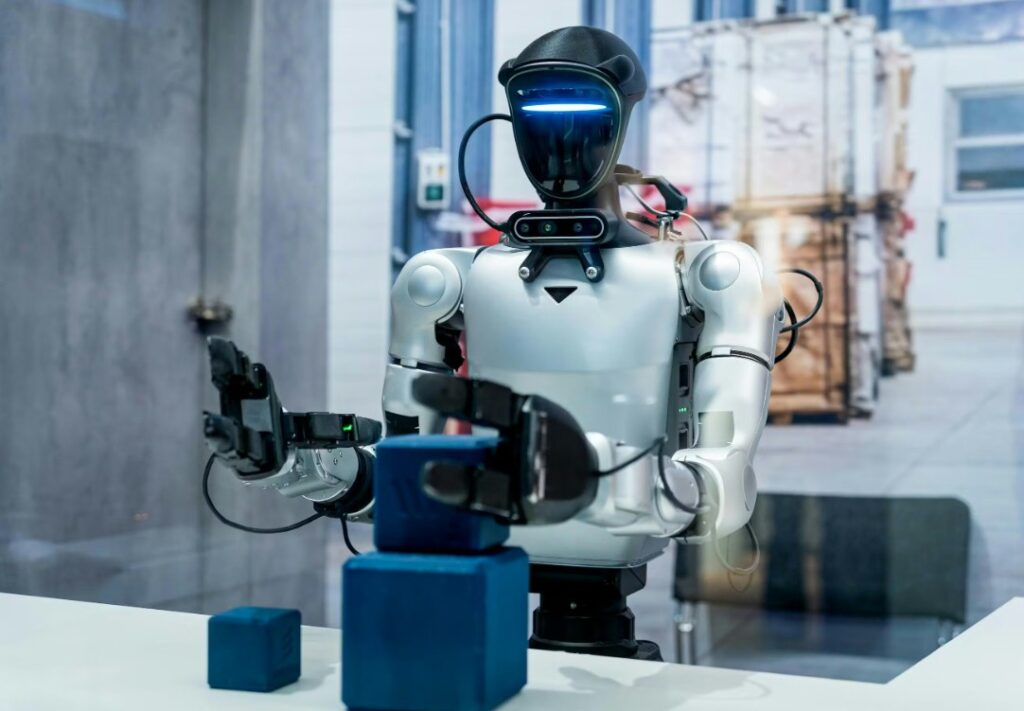
As humanoid robots move from research labs into warehouses, factories, and logistics centers, engineers are confronting a new class of safety problems that traditional industrial standards were never designed to handle. An article in Machine Design by FORT Robotics CTO Nathan Bivans argues that the next frontier in humanoid safety is not collision avoidance alone, but dynamic stability, the ability of robots to maintain balance and respond intelligently during unexpected situations.
Conventional industrial robot safety systems were developed around stationary robotic arms fixed to factory floors. Standards such as ISO 10218 focus heavily on fenced work zones, emergency stops, and predictable motion paths. Humanoid robots, however, introduce far more complicated physics. These machines are mobile, carry significant mass, and operate with more than 20 degrees of freedom, meaning their center of gravity constantly shifts during movement.
The article explains that a standard emergency stop may actually increase danger in a humanoid robot. If power is suddenly cut while a walking robot is balancing dynamically, the machine can collapse uncontrollably, potentially causing more harm than the original hazard. Instead of simply stopping motors, engineers must manage momentum, posture, and controlled deceleration in real time.
Bivans argues that future robotic safety systems must become context-aware rather than purely reactive. Current safety architectures often operate through rigid binary logic: if a risk appears, stop everything immediately. Humanoid systems require more nuanced responses, such as slowing down, rerouting, adjusting gait, or pausing temporarily while maintaining stability. The proposed approach introduces layered safety architectures capable of continuously evaluating environmental conditions, robot intent, and operational risk.
The article also highlights the growing tension between physical AI systems and outdated safety regulations. As humanoids begin operating in dynamic industrial environments alongside human workers, safety must evolve into a distributed “safety fabric” that integrates sensors, APIs, wireless communication, and predictive modeling. Concepts such as real-time stability envelopes, contextual authorization, and coordinated machine awareness are becoming increasingly important.
According to the article, the robotics industry is entering a transition similar to earlier shifts in aviation and automotive safety engineering. Humanoid robots are no longer experimental demonstrations; they are becoming operational systems expected to work continuously in complex environments. Ensuring their reliability will require safety frameworks that treat stability as a continuously managed engineering variable rather than a simple on-or-off condition.
