

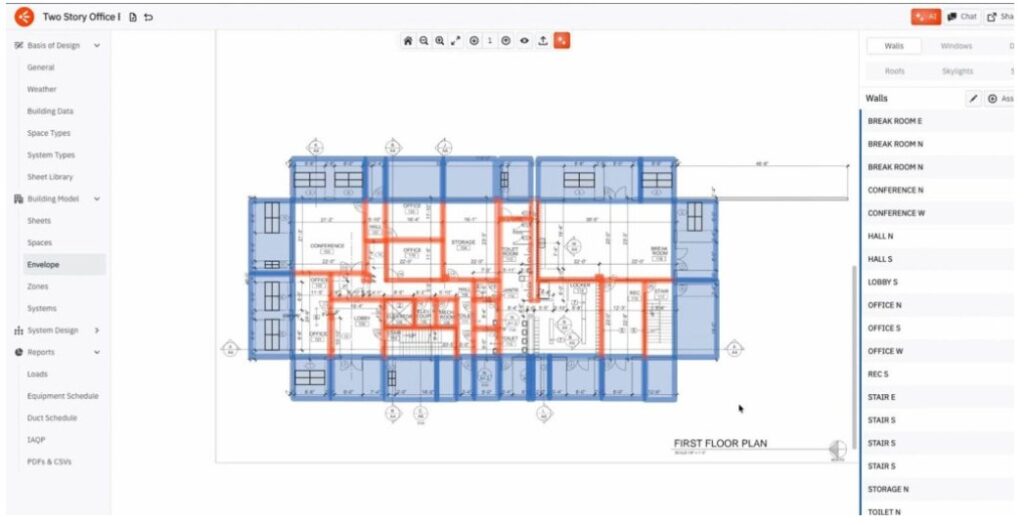
Artificial intelligence is beginning to reshape mechanical engineering workflows in architecture, engineering, and construction, and HVAKR represents one of the clearest examples of that transition. AEC Magazine reports that the California-based startup has developed a cloud-native HVAC design platform that integrates load calculations, duct layouts, and AI-assisted engineering tools into a single workflow environment.
Traditionally, HVAC engineers rely on disconnected software systems and spreadsheets to perform separate tasks such as thermal load calculations, airflow sizing, and duct routing. This fragmented process often forces engineers to manually re-enter data whenever architectural changes occur, increasing the risk of inconsistencies between analytical models and physical layouts. HVAKR aims to eliminate those inefficiencies by consolidating the entire workflow into one continuously synchronized platform.
The platform supports the full sequence of mechanical design work, including basis-of-design setup, space zoning, psychrometric analysis, equipment sizing, airflow calculations, and duct annotation. Engineers can import architectural floor plans directly into the web application, allowing HVAC systems to be developed visually rather than through isolated spreadsheets or desktop software. Any modification to glazing, occupancy, or building envelope conditions automatically propagates throughout the project model, updating airflow demands, equipment sizing, and duct parameters in real time.
The most significant aspect of the platform is its AI layer. HVAKR positions its system as a mechanical engineering assistant capable of interpreting floor plans and responding to natural language prompts. The AI can establish initial project settings, assign zoning, modify envelope properties, and perform bulk design edits through conversational instructions. It can also analyze building performance data, identify unusually high cooling loads, and help engineers validate system behavior more quickly.
Future development plans include automated diffuser placement, generative duct routing, and side-by-side HVAC system comparisons. The platform also integrates with Revit-based BIM coordination workflows, reflecting the growing trend toward discipline-specific AI tools in the AEC sector.
The emergence of tools such as HVAKR suggests that AI adoption in engineering may advance first through specialized technical workflows rather than through broad BIM replacement platforms. By embedding automation directly into mechanical design processes, the software highlights a larger shift toward agentic engineering systems capable of accelerating calculations, coordination, and design iteration.
