

Researchers at MIT have developed a new artificial intelligence framework designed to improve planning for complex visual tasks such as robot navigation and coordinated assembly. The method integrates generative AI with classical planning tools, enabling machines to analyze an image of a scenario and generate a sequence of actions needed to reach a desired goal.
Planning tasks that involve visual information remain challenging for AI systems because they require understanding the environment, predicting outcomes, and organizing a series of steps that may extend far into the future. Existing approaches often rely either on machine-learning models that interpret images or on formal planning systems that compute optimal actions. Each approach has limitations when used alone. Vision-language models can interpret scenes but may struggle to produce reliable long-term plans, while classical planners require carefully structured inputs that are difficult to generate automatically.
The MIT team addressed this gap by creating a hybrid, two-stage process. First, a specialized vision-language model examines an image of a task environment and simulates possible actions needed to reach a goal. Next, another model translates those simulated actions into a structured programming language commonly used in automated planning systems. The resulting files can then be processed by a classical planning solver to generate a final sequence of actions.
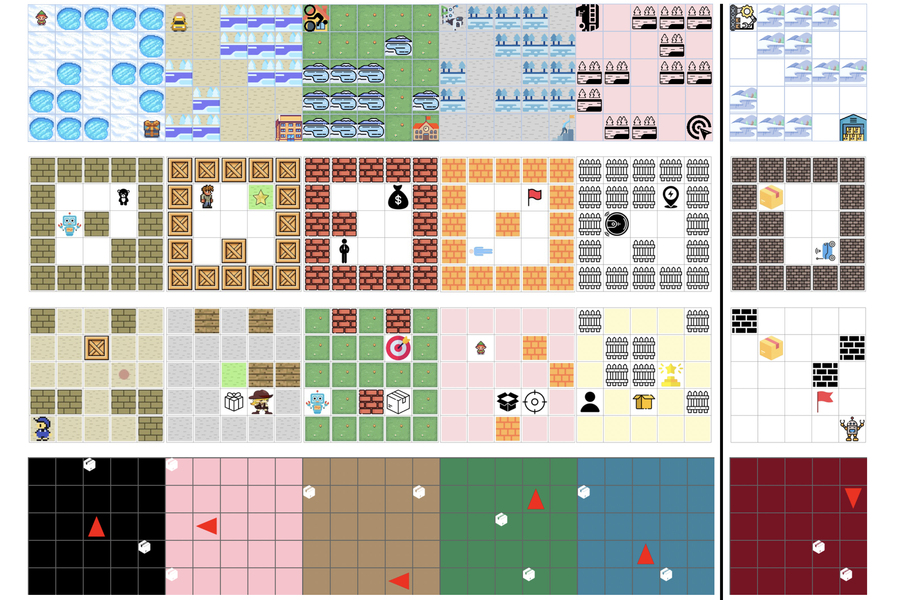
Tests of the system demonstrated substantial improvements over existing techniques. In experiments across multiple simulated environments, including grid-based tasks that resemble simple video games, the approach produced successful plans roughly 70% of the time. Comparable baseline methods achieved success rates closer to 30%.
A key advantage of the framework is its ability to generalize to new problems. Because the method combines visual interpretation with formal reasoning, it can generate plans for scenarios it has not previously encountered. This capability could prove valuable in dynamic real-world settings where robots must adapt to changing environments.
Researchers suggest the approach could improve applications ranging from autonomous robot navigation to multi-robot manufacturing systems. By linking modern generative AI with established planning algorithms, the system offers a promising path toward machines capable of understanding complex scenes and translating that understanding into reliable long-term strategies.
