

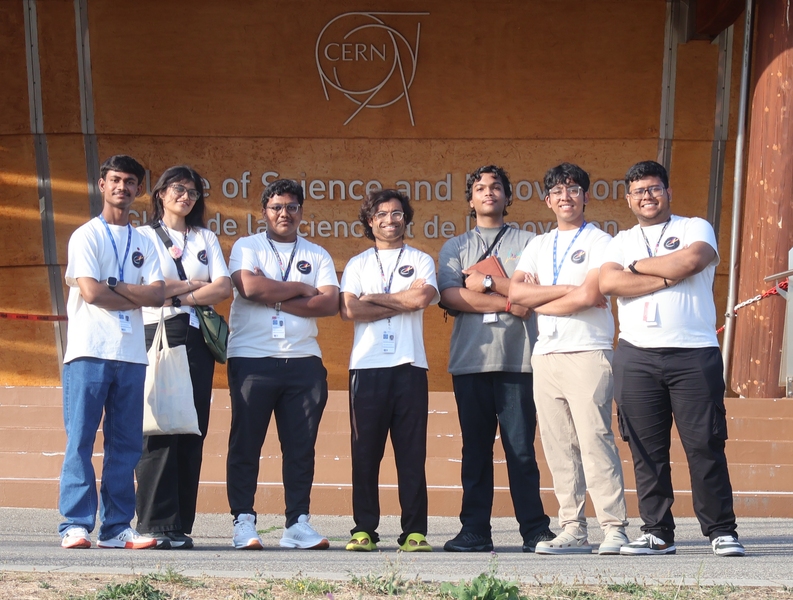
Six high school students from India turned an ambitious particle physics idea into an experiment at CERN with help from MIT physics graduate student Manu Srivastava. The students contacted Srivastava while preparing an entry for CERN’s Beamline for Schools competition, which allows secondary school students to design experiments using particle accelerator beams, tells MIT News.
Calling themselves Team attoPION, the students were selected as one of five teams from a record 712 entries representing 89 countries and more than 4,500 students. Srivastava helped them evaluate their initial ideas and identify an experiment that was both scientifically meaningful and practical.
The team chose to study pion charge exchange. Pions are short-lived subatomic particles that can have positive, negative, or neutral charges. Their experiment examines a process in which a positively charged pion interacts with a neutron, producing a neutral pion and a positively charged proton. The students aim to measure how frequently this reaction occurs.
The results could potentially contribute to the Deep Underground Neutrino Experiment, or DUNE. Researchers need accurate information about pion interactions with matter because these interactions can introduce uncertainties when determining a neutrino’s energy and flavor. Better measurements could therefore improve the interpretation of DUNE data.
At CERN, the students spent two weeks working with detectors and data-acquisition systems, collecting and analyzing data, and attending presentations by scientists. They also confronted a major challenge: the charge-exchange process they hoped to observe is extremely rare.
For Srivastava, a theoretical physicist studying quantum gravity at MIT, mentoring the experiment required stepping outside his own research specialty. Having grown up in India, he also viewed the project as an opportunity to encourage young Indian students interested in fundamental science.
The experience demonstrates how mentorship can give students access to authentic scientific research while teaching them to navigate uncertainty, technical limitations, and experimental problem-solving.
