

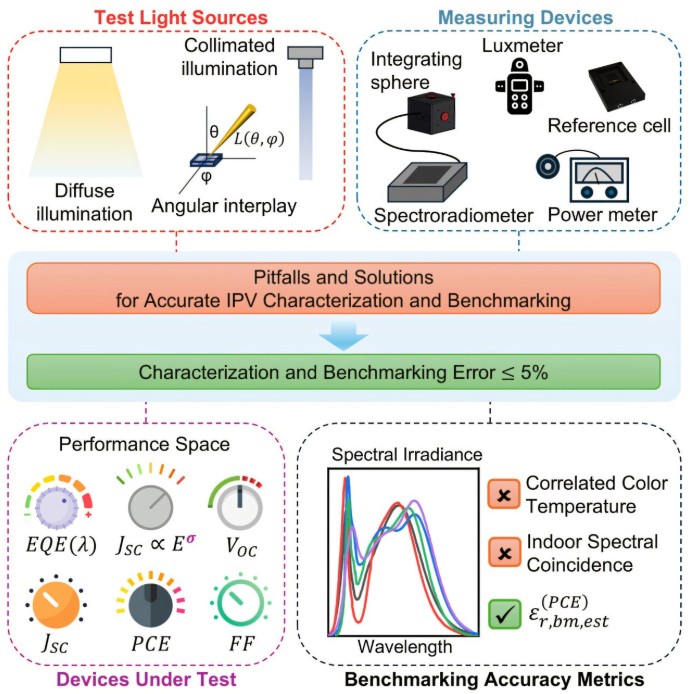
As smart devices proliferate in homes, offices, and cities, the power supply becomes an increasing concern. Many of these devices depend on disposable batteries, which generate waste and pollution. An alternative is indoor photovoltaics: solar-like cells that harvest ambient indoor light rather than direct sunlight, providing a route to truly maintenance-free power for sensors, IoT devices, and embedded systems, tells Tech Xplore.
The challenge, however, lies not in the concept but in measurement. Indoor lighting varies substantially, including spectrum, brightness, shape of room, and distance to source, all differ in contrast to the relatively standard outdoor sunlight context. Because of this variability, reported efficiencies of IPVs across labs often differ wildly and cannot be reliably compared.
The SFU team investigated how different testing conditions skew results. They found that diffuse or scattered indoor light tends to degrade measurement accuracy and render efficiency claims unreliable. Additionally, they point out that typical terms such as “warm white” or “cool white” for indoor bulbs are insufficient to characterize the real spectrum environments that IPVs face.
To improve matters, they proposed a “universal reference cell” that can standardize indoor lighting conditions across labs. Along with guidelines for consistent measurement protocols, these are meant to establish benchmarks and compare IPV performance fairly. Better standardization would help device designers, manufacturers, and system integrators trust IPV data and make informed choices for product deployment.
For engineers working on smart-device infrastructure, this signals a meaningful shift: integrating power harvesting as a design variable rather than relying solely on batteries or mains supply. The article suggests that with proper measurement standardization, IPVs may transition from niche research to foundational tech in smart buildings, wearables, and pervasive sensing networks.
Ambient indoor light is a resource, but realizing its potential depends on rigorous, comparable metrics. Without them, claims of “zero-battery” devices remain aspirational.
