

A new infrared imaging technology is advancing the ability to see clearly in challenging environments such as fog, smoke, and low-light conditions. Developed by researchers at the Daegu Gyeongbuk Institute of Science and Technology, the innovation focuses on short-wave infrared (SWIR) sensing, a region of the spectrum known for its ability to detect objects even when visibility is severely reduced, tells Tech Xplore.
Traditional SWIR sensors rely on expensive compound semiconductors such as indium gallium arsenide, which limits scalability and widespread adoption. To overcome this barrier, the research team designed a hybrid photosensor that combines silver telluride quantum dots with a two-dimensional semiconductor material, molybdenum disulfide. This pairing leverages the strong light absorption of quantum dots and the fast charge transport of the semiconductor, addressing the weaknesses of each material when used alone.
A key feature of the system is its ability to amplify weak infrared signals through a phenomenon known as photodoping, which occurs at the interface between the two materials. This enables the sensor to achieve high responsivity and detectivity, allowing it to capture faint signals quickly and accurately. The result is a device capable of identifying objects in conditions where conventional cameras struggle.
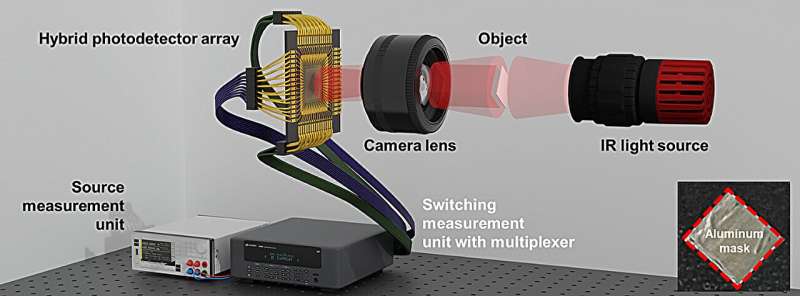
Beyond laboratory performance, the researchers demonstrated practical viability by fabricating a 32 × 32 pixel infrared image sensor array. This marks an important step toward real-world imaging applications, showing that the technology can move beyond single-device prototypes. The design is also compatible with existing CMOS manufacturing processes, making it easier to integrate into current production pipelines.
The implications extend across multiple fields. Autonomous vehicles, robotics, surveillance systems, and medical imaging all rely on accurate sensing in low-visibility environments. By offering a lower-cost and scalable alternative to existing sensors, the technology could accelerate adoption in these areas.
This development highlights a broader trend in sensor design: combining materials at different scales to unlock new performance capabilities. By bridging quantum-level absorption with fast electronic transport, the research points toward more efficient, sensitive, and accessible imaging systems for next-generation applications.
