

SAN DIEGO, CA, Mar 30, 2026 – Innatera has introduced Synfire, a platform designed to unify development and deployment in neuromorphic AI. The platform is open for registration and will be available in late April. Presented at Edge AI San Diego 2026, Synfire addresses fragmentation across tools, models, and deployment pipelines in neuromorphic systems.
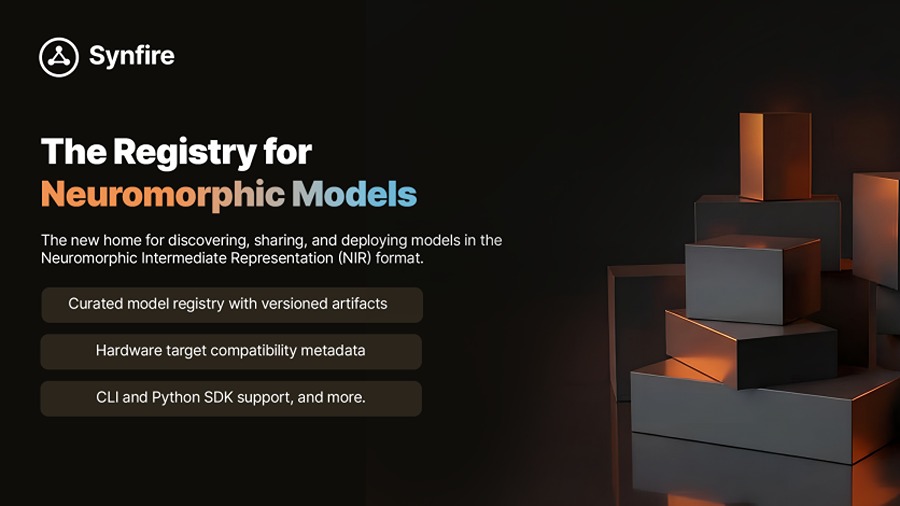
Synfire addresses a gap between neuromorphic research and deployment, where lack of interoperability, reproducibility, and model exchange slow adoption. It provides a repository for neuromorphic models and processing pipelines, allowing developers to publish, discover, and deploy spiking neural network (SNN) solutions.
“Progress for neuromorphic networks follows a clear path. First, we make them usable by building the infrastructure, tools, and shared foundations that allow people to work with them. Then, we make them useful, enabling them to solve real problems, adapt to real environments, and deliver real impact,” says Steve Furber, professor emeritus of computer engineering at the University of Manchester. “Creating a community-driven platform like Synfire, accelerates this transition by offering developers the opportunity to lead innovation in this space.”
Built for neuromorphic computing, the platform supports temporal and event-driven models and includes hardware-aware discovery and reproducibility metadata. It packages workflows that cover preprocessing, encoding, inference, and actuation.
“Synfire is how neuromorphic computing gets out of the lab. Current AI hardware was not built for real-world intelligence. Neuromorphic systems are, but only if models, benchmarks, and hardware can speak the same language,” notes Dr. Jens Egholm, lead author for neuromorphic intermediate representation and neuromorphic computing researcher. “The Neuromorphic Intermediate Representation (NIR) provided that shared language. Synfire builds the commons on top of it. Upload once, run anywhere, reproduce everything, and build on each other’s work to go further than before.”
A Platform Designed for Deployment
Synfire introduces a new foundation for the neuromorphic community through:
- Open model registry for publishing and discovering SNN-based solutions
- Hardware-aware metadata to match models with validated execution targets
- Web platform, CLI, and SDK integration for developer workflows
- Extensible architecture aligned with standards such as NIR
A Community-Led Effort to Drive Convergence
Synfire is designed as a vendor-neutral open infrastructure, co-steered with research communities.
“We have made incredible progress in neuromorphic hardware and model design, but the surrounding ecosystem is still fragmented. There is no consistent way to capture how a model was built, how it should run, or where it has been validated,” adds Petruț Antoniu Bogdan, neuromorphic architect at Innatera. “That makes reuse difficult and slows down real deployment. Synfire introduces structure to fill these gaps by standardizing how models are shared, while remaining flexible enough to evolve with the field. While perfecting the tools is a key milestone, our true goal is to build a coherent ecosystem that can efficiently build on top of published work and deploy to a variety of neuromorphic devices with minimal manual work, all the while maintaining the original model performance.”
Moving from Fragmentation to Scale
Synfire introduces a different approach to how neuromorphic systems are built, shared, and deployed, with applications in areas such as smart sensing, industrial automation, healthcare, and consumer devices.
Source: Innatera
About Innatera

Innatera develops neuromorphic processors designed to run AI on edge devices. The company builds neuromorphic microcontrollers that process sensor data using spiking neural network architectures. These products support real-time data processing while reducing power consumption and dependence on cloud computing. Innatera serves original equipment manufacturers and developers across automotive, industrial systems, wearables, smart home devices, and IoT applications. The company was founded in 2018 as a spin-off from Delft University of Technology. Innatera is headquartered in Rijswijk, Netherlands. It focuses on R&D, and integration of neuromorphic hardware for commercial products. Its technology targets use cases requiring low latency, continuous sensing, and efficient on-device intelligence. Applications include pattern recognition, event detection, and condition monitoring in embedded systems.
