

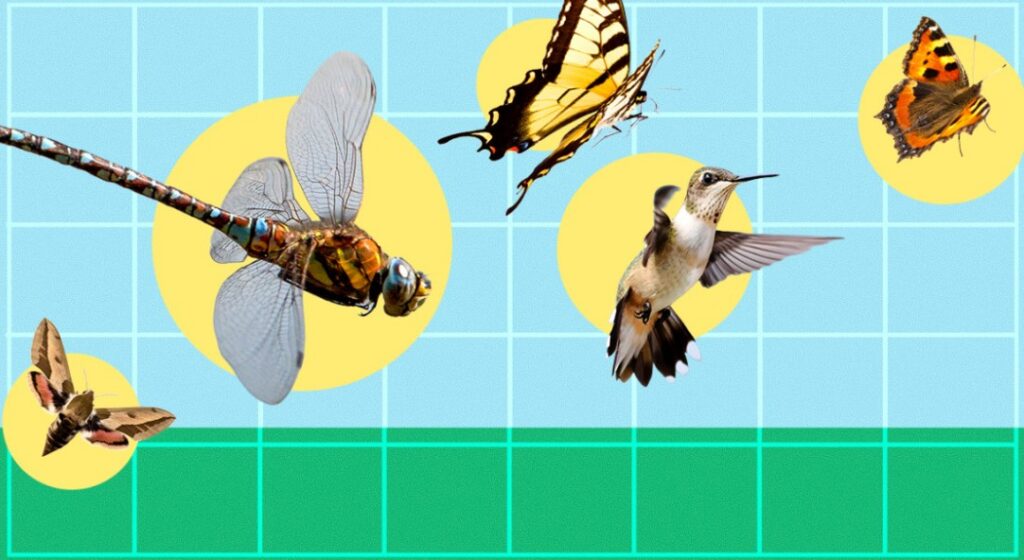
Researchers at Cornell University have gained new insight into the mechanics of insect flight, revealing aerodynamic behaviors that could improve the stability and maneuverability of future flapping-wing robots. The study focused on understanding how insects maintain control during rapid wing movements and sudden environmental disturbances, a challenge that has long limited the development of small flying robots inspired by nature.
According to the article, insects achieve remarkable aerial stability despite operating in highly unstable aerodynamic environments. Tiny disturbances in airflow can dramatically affect flight at small scales, yet insects routinely hover, dart, and recover from disruptions with extraordinary precision. Cornell researchers sought to understand the physical mechanisms behind this ability by combining experiments, mathematical modeling, and robotic simulations.
The team discovered that certain vortex interactions generated during wing flapping naturally contribute to flight stability. As insects flap their wings, they create swirling air structures known as leading-edge vortices. These vortices not only generate lift but also help stabilize motion by responding dynamically to changes in wing orientation and body movement. The researchers found that subtle timing and wing-motion adjustments allow insects to maintain controlled flight without relying entirely on complex neural corrections.
This finding could significantly influence the design of micro aerial vehicles, particularly flapping-wing robots intended for environments where conventional drones struggle. Traditional quadcopters often require constant electronic stabilization systems and may perform poorly in confined or turbulent spaces. In contrast, insect-inspired robots could potentially achieve more natural stability through aerodynamic design itself, reducing computational demands and improving energy efficiency.
The article explains that the research may support applications ranging from environmental monitoring and disaster response to precision agriculture and infrastructure inspection. Small flapping robots capable of stable flight in cluttered environments could access spaces too dangerous or inaccessible for larger machines.
Beyond robotics, the work also deepens scientific understanding of biological flight. Insects evolved highly efficient flight systems over millions of years, and engineers increasingly view them as models for solving difficult aerospace problems. The Cornell study demonstrates that stable flight may emerge not only from active control systems but also from carefully tuned aerodynamic interactions embedded directly into wing motion and structure.
