

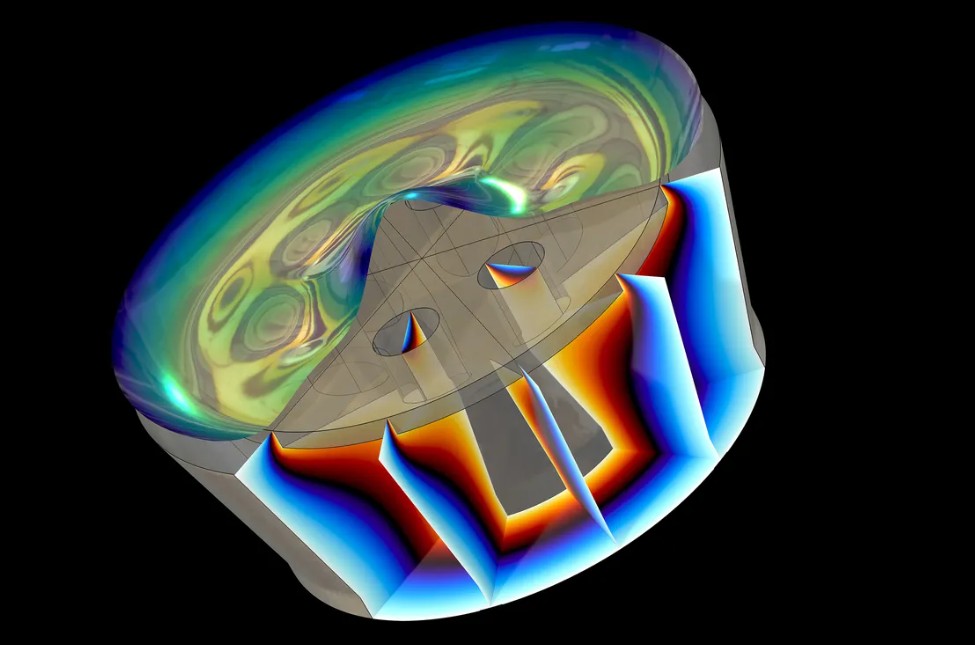
In engineering and science, multiphysics simulations, that is, solving coupled equations across thermal, structural, electromagnetic, fluid, and chemical domains, are powerful tools. But they bite: they’re slow, computationally intensive, and often impractical for real-time decision making. At a recent COMSOL user conference, researchers and engineers explored a promising workaround: surrogate models, tells IEEE Spectrum.
A surrogate model is a simplified version of a full simulation. It’s trained (using machine learning or reduced-order modeling) on data from the full model, capturing essential relationships without re-solving every equation. The payoff: prediction times drop from minutes (or more) to milliseconds. COMSOL plans to let users compile these surrogate models as standalone applications. That means clients or factory operators could run them locally (on laptops, edge devices, or smartphones) without needing a licensed COMSOL setup.
In one example, European automakers use surrogate models to simulate battery packs in near real time, supporting design iterations or in-process diagnostics. In another case, a Swiss institute released an app (built from a surrogate) that lets Indian cold storage farmers forecast spoilage and adjust settings. The result: a 20% reduction in food waste.
COMSOL combines several strategies to build these models. Neural networks help, but so do traditional reduced-order modeling methods. Engineers produce a dataset by running the high-fidelity model at carefully selected points, then fit the surrogate to interpolate or extrapolate to new inputs. The surrogate model might disregard negligible terms or use pattern recognition to compress equations.
There are limits. Surrogates tend to be accurate only within the domain they were trained on. If input parameters go far outside the training set, predictions may degrade. Also, managing uncertainty and ensuring stability are ongoing challenges. The next frontier: building surrogates that are trustworthy across broader operating ranges, or that self-adapt when inputs drift beyond their safe zone.
Surrogate models might turn models from something you wait for into something you interact with, making multiphysics simulation as instant as using an app.
