

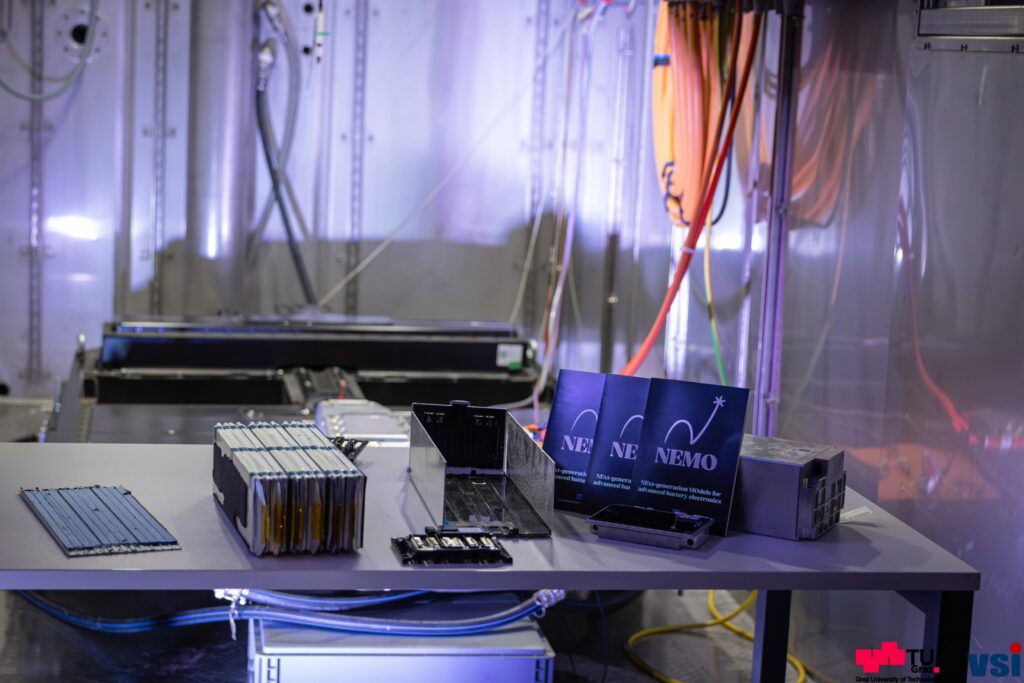
Researchers from Graz University of Technology (TU Graz), the Vrije Universiteit Brussel, and industry partners have developed an advanced battery management system (BMS) that could significantly improve the safety, lifespan, and performance of electric vehicle batteries. Created as part of the EU-funded Nemo project, the system introduces intelligent models and algorithms capable of monitoring battery health directly within the vehicle, providing insights that conventional battery management systems cannot offer.
Traditional BMS technology primarily relies on measurements of voltage, current, and temperature to assess battery condition. As a result, signs of aging or damage can only be inferred through complex external calculations. The new system takes a more direct approach by incorporating advanced monitoring tools that can identify faults, degradation, and safety risks at the individual cell level.
Researchers at TU Graz’s Vehicle Safety Institute focused on battery safety by studying cells that had been mechanically deformed to simulate real-world damage, such as impacts that might occur during parking incidents. Using data collected from these experiments, the team trained algorithms capable of detecting damage independently and signaling when maintenance may be required.
A key component of the system is electrochemical impedance spectroscopy (EIS), a sensor technology that measures electrical resistance within battery cells. This allows the BMS to gather information about the internal condition of the cells rather than relying solely on external indicators. The researchers also developed a model that predicts changes in cell volume during charging and discharging. Since excessive expansion can create mechanical stress, cracks, and internal short circuits, the model helps reduce the risk of thermal events and battery failure.
Meanwhile, researchers at the Vrije Universiteit Brussel developed algorithms that provide detailed insights into battery aging. Unlike conventional methods that only track capacity loss, the new models reveal internal changes occurring as cells degrade, enabling smarter control strategies that improve safety and extend service life.
Despite these enhanced capabilities, the system requires only modest hardware additions. A module-level demonstrator has already been built, and a follow-up project is underway to further refine the technology and prepare it for future commercial deployment in electric vehicles.
