

Fully homomorphic encryption (FHE) has long been viewed as one of the most promising technologies for protecting digital privacy. The concept allows computers to perform calculations directly on encrypted data, eliminating the need to decrypt sensitive information during processing. In theory, this approach could enable secure medical research, financial analysis, and cloud computing without exposing private data. In practice, however, FHE has remained largely impractical because the calculations are extremely slow on conventional hardware, tells IEEE Spectrum.
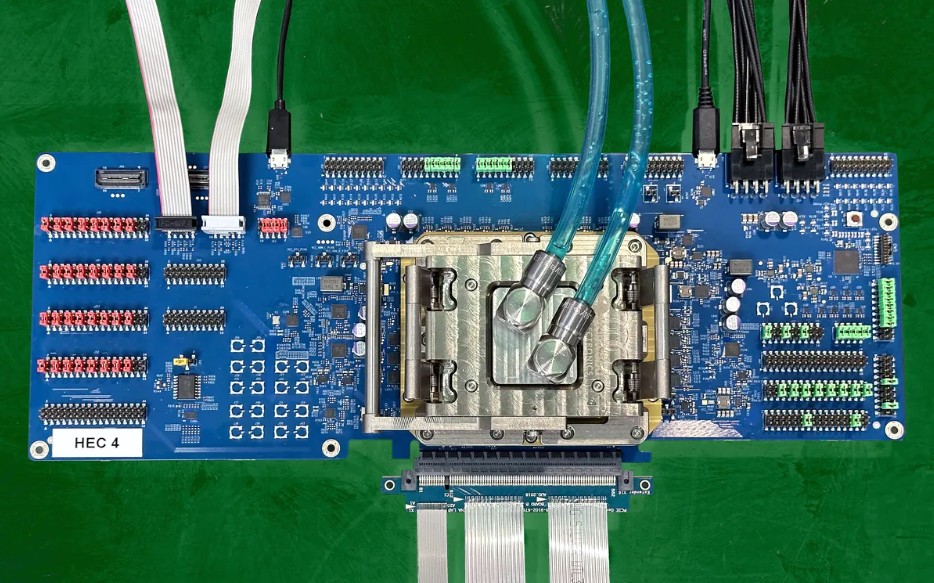
To address this challenge, Intel has developed a prototype chip designed specifically to accelerate FHE operations. The processor, known as Heracles, was recently demonstrated at the IEEE International Solid-State Circuits Conference. According to Intel, the chip can perform certain encrypted computing tasks up to 5,000 times faster than a high-end Intel server CPU running the same workload in software. This performance improvement could significantly reduce the main barrier preventing FHE from being widely adopted.
The Heracles chip is built using advanced 3-nanometer FinFET technology and incorporates large amounts of high-bandwidth memory similar to configurations used in modern AI accelerators. The design enables the processor to handle the unusual mathematical operations required by FHE algorithms more efficiently than general-purpose CPUs or GPUs. Intel researchers say the chip represents the first hardware capable of executing FHE workloads at a meaningful scale.
The potential applications are broad. Encrypted computing could allow people to query sensitive databases without revealing their identities or personal information. In one demonstration scenario, a voter checks whether a ballot has been correctly recorded in an election database. Using FHE, the system can verify the information while keeping both the database and the user’s data encrypted throughout the process.
Intel is not alone in pursuing this technology. Universities and startups are also developing specialized processors aimed at accelerating FHE. If these efforts succeed, computing on encrypted data could become practical for cloud services, artificial intelligence systems, and other data-intensive applications.
Such progress would mark a significant shift in cybersecurity, enabling organizations to analyze sensitive information while preserving confidentiality at every stage of computation.
