

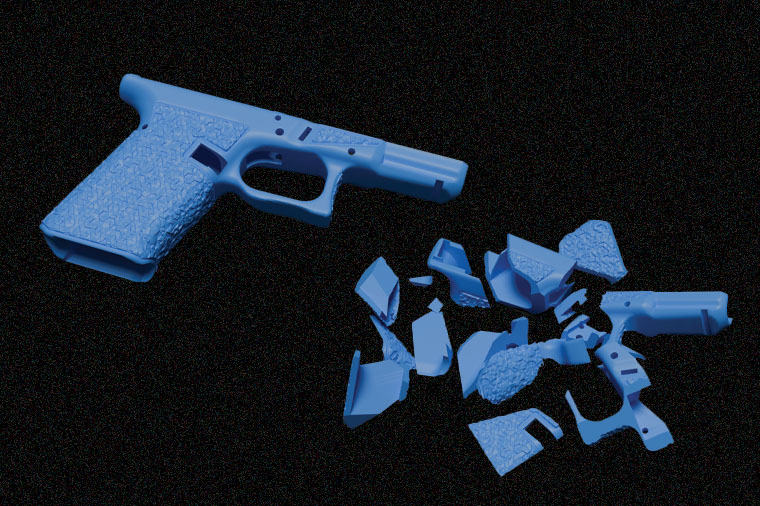
Researchers at Washington University are working on a method to embed unique identifiers, or “fingerprints,” within 3D-printed parts, reports 3D Printing Industry. The goal is to make it possible to trace parts back to their source, especially when they are used to produce so-called “ghost guns” (guns made without serial numbers, often via 3D printing), or otherwise misused components.
These embedded fingerprints are subtle physical or material markers integrated during the printing process. They could be microscopic patterns, variances in material composition, or internal structures that are not visible on the exterior but detectable under certain scans or imaging. Such markings allow law enforcement or regulators to identify which printer, machine, or batch produced a part.
Ghost guns have become a growing concern because 3D printing allows almost anyone with access to the right equipment and plans to manufacture untraceable firearms. Traditional serial number systems are bypassed when parts are fabricated at home or by unlicensed entities. Embedding fingerprints provides a pathway to restore accountability.
Challenges include ensuring the fingerprint doesn’t compromise the structural integrity of the part, keeping the cost of adding the identifier low, and making the detection process practical (requiring imaging hardware, non-destructive scanning, etc.). There are also concerns about privacy, regulation, and whether such marks could be removed or spoofed.
Implications extend beyond firearms. Tracked 3D-printed parts could be used in industrial safety, aerospace, medical implants, etc., where traceability of component origin is important for quality control, failure analysis, or regulatory compliance.
The Washington University project aims to give 3D-printed parts an invisible signature to help trace their origins, with applications for security, safety, and accountability, while overcoming technical, ethical, and practical hurdles.
