

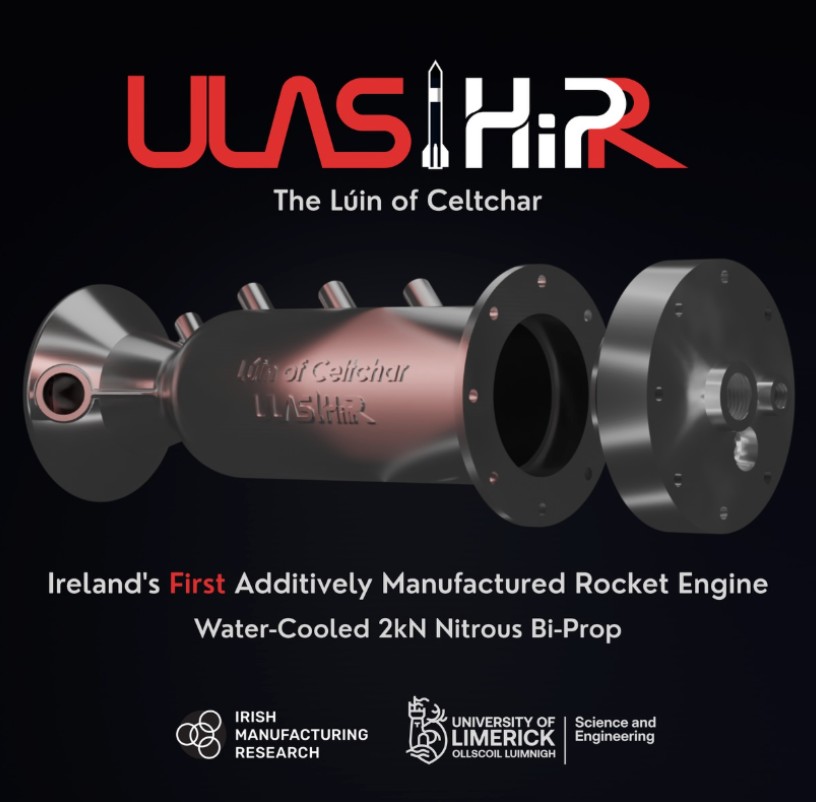
Ireland has taken a significant step in its emerging space technology sector with the development of the country’s first liquid rocket engine manufactured using metal additive manufacturing. The project, led by the University of Limerick’s UL Aerospace Society (ULAS) HiPR student team in partnership with Irish Manufacturing Research (IMR), has moved from the design phase into active production, tells 3D Printing Industry Blog.
The engine, named Lúin of Celtchar, is designed as a bipropellant system capable of producing approximately 2 kilonewtons of thrust. It operates using isopropyl alcohol as fuel and nitrous oxide as the oxidizer. While relatively small compared with large commercial rocket engines, it represents an important technological milestone for Ireland’s aerospace research ecosystem.
Production of the engine components is being carried out using metal additive manufacturing techniques at IMR’s Advanced Manufacturing Lab in Mullingar. The process involves printing complex metal parts layer by layer, enabling engineers to produce intricate internal structures that would be difficult or impossible to manufacture with conventional machining methods. Once printed, the components are returned to the University of Limerick for precision machining, finishing, and final assembly. This approach keeps the entire development and manufacturing workflow within Ireland.
The project demonstrates the growing role of additive manufacturing in rocket propulsion development. By consolidating multiple components into fewer printed parts, engineers can reduce assembly complexity while accelerating development cycles. Additive techniques also allow for rapid iteration of engine designs during testing and optimization.
Beyond the technical achievement, the initiative highlights the importance of collaboration between academia and industry in advancing aerospace capabilities. The partnership between UL researchers, student engineers, and IMR provides access to advanced manufacturing facilities while giving students hands-on experience in propulsion engineering. The engine will also compete in the Race2Space 2026 program, a competition focused on developing student-built rocket technologies.
As additive manufacturing continues to transform aerospace production, projects such as this illustrate how smaller research ecosystems can participate in the global space industry. Ireland’s first 3D-printed rocket engine marks an early but significant step toward building domestic expertise in advanced propulsion technologies.
